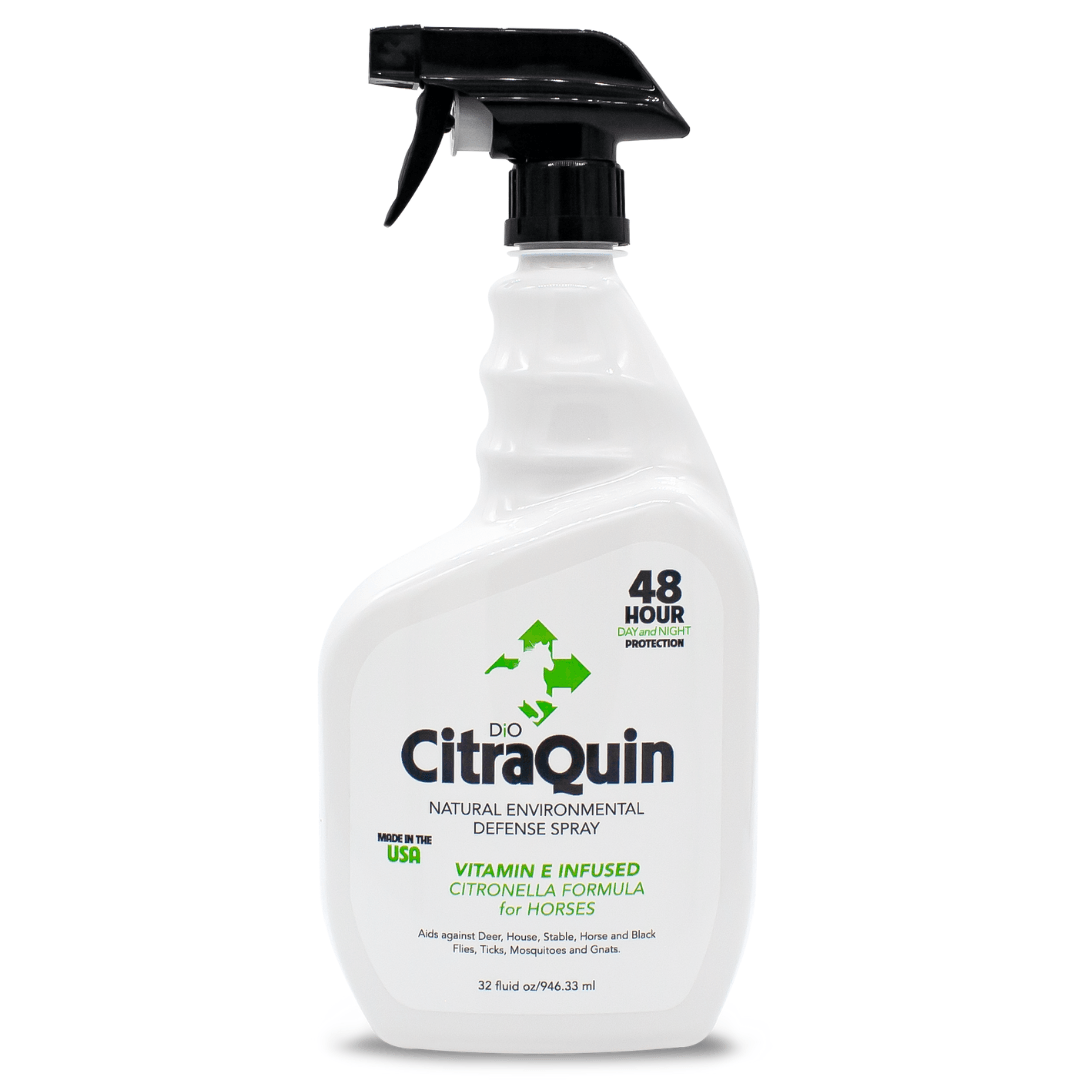
Citraquin® Environmental Defense Spray for Horses (32 oz)

A naturally derived fly spray for horses built for routine use around barns and turnout. Designed to support daily fly management without synthetic insecticides, with a lightweight, fast-drying feel.

Buy together & save

Citraquin® Environmental Defense Spray by Draw It Out® 32oz - Draw it Out®
Citraquin® Spray Protecteur Environnemental 946 ml | Répulsif Naturel Contre les Mouches pour Chevaux

32 onces

27 Commentaires
Prix
$25.45
Taxes et livraison calculées à la caisse
Taille: 32 onces

Citraquin® Spray Protecteur Environnemental 946 ml | Répulsif Naturel Contre les Mouches pour Chevaux

Taille
Prix
32 onces
Prix
$25.45
Lot de 2
Prix
$46.99
Comparez les options de produits
Draw It Out Seasonal Item

Seasonal Favorite

Limited-time formulas and fan favorites — available while supplies last.

Le Citraquin® Environmental Defense Spray (946 ml) est un spray anti-mouches d'origine naturelle, à base de plantes, conçu pour une utilisation répétée autour des chevaux, des étables et des pâturages. Il est destiné aux cavaliers qui souhaitent une routine constante, une application simple et une transparence des ingrédients.

  • Adapté à la routine : Conçu pour un usage quotidien pendant la saison des mouches.
  • Sans insecticides synthétiques : Conçu à base d'huiles aromatiques végétales au lieu d'actifs chimiques conventionnels.
  • Exclusions demandées par les cavaliers : Ne contient pas de DEET, de perméthrine, de pyréthrines ou de pyréthroïdes.
  • Prêt à l'emploi : Pas de mélange. Pas de dilution.
  • Sensation de propreté dans l'étable : Application légère avec un profil de parfum botanique frais.

Comment les cavaliers l'utilisent généralement

  • Bien agiter avant utilisation.
  • Tenir le flacon à environ 15 à 20 cm du pelage.
  • Appliquer légèrement et uniformément. Éviter les yeux, les narines et les zones sensibles.
  • Pour les zones du visage, vaporiser sur un chiffon et essuyer doucement.
  • Réappliquer selon les besoins en fonction de la sortie, de la transpiration, de la pluie et de la pression des insectes.

Note multi-surfaces : De nombreux cavaliers utilisent Citraquin® autour des portes des stalles et des zones de l'étable sujettes aux mouches, ainsi que sur les couvertures ou les séchantes. Faire un essai sur une petite surface et laisser sécher avant une utilisation complète.

Disponibilité : Non disponible à la vente en Indiana en raison de la classification et des exigences d'enregistrement des produits spécifiques à cet État.

Les résultats varient en fonction de la météo, de la sortie et de la gestion de l'étable. La plupart des cavaliers utilisent Citraquin® comme l'un des éléments d'une routine plus large de lutte contre les mouches.

Botanical Components & Routine Use Notes

Citraquin® is built around plant-derived aromatic oils that riders commonly choose during fly season. The goal is routine compatibility and straightforward daily use, without relying on synthetic insecticides.

Cedarwood Oil

Cedarwood contributes a bold, barn-ready aromatic profile that many riders prefer for day-to-day fly season routines. It helps define the scent character of the formula without pushing the product into “heavy” territory.

Citronella Oil

Citronella is a familiar botanical aroma in fly spray routines. In Citraquin®, it supports the overall fly-season profile while keeping the formula positioned away from synthetic insecticides.

Wintergreen Oil

Wintergreen is used in small amounts to round out the aromatic balance. It is included for scent character and formula harmony, not as a standalone “active.”

Vitamin E & Castor Oil

Vitamin E and castor oil are commonly used in topical routines to support skin tolerance and coat feel during repeat application.

Citraquin® does not contain DEET, permethrin, or pyrethrins. It is designed to fit routine fly management programs used by riders and barns.

Common Fly Season Exposure

During fly season, horses and barns commonly deal with changing insect pressure. This list reflects common exposures riders plan for in day-to-day turnout and barn routines.

Horse Flies
Deer Flies
Stable Flies
House Flies
Black Flies
Ticks
Mosquitoes
Gnats

Results vary by weather, turnout, and barn management. Most riders use Citraquin® as one piece of a broader fly season routine. For ticks, routine inspection and prompt removal are always part of good barn practice.

Fly season is mostly about repeatable routines: turnout timing, stall habits, and what you keep on hand. If you want the full playbook, start here: Fly protection routine tips for horses.

Multi-Animal & Multi-Surface Use

Shake well, apply lightly, and keep it part of a repeatable fly season routine.

For Horses

  • Shake well before use.
  • Hold bottle about 6–8 inches from the coat.
  • Spray over the body, avoiding eyes, nostrils, and sensitive areas.
  • Reapply as needed based on turnout, sweat, and weather.

Beyond Horses

  • Dogs: Many riders use a light mist on the coat. Avoid the face. Spot test first.
  • Other barn animals: If used, apply lightly to the coat and avoid eyes and mucous areas. Spot test first.
  • Stalls & surfaces: Light mist on stall doors, walls, and fly-prone areas. Let dry before animals return.
  • Sheets & coolers: Light mist, spot test on a small area first, then allow to dry before use.

Note: Scent is botanical and crisp. As with any barn-use spray, spot testing is the safest default for sensitive animals and textiles.

Environmental & Regulatory Context

Citraquin® is formulated without synthetic insecticides commonly found in conventional fly sprays. The focus is a routine-friendly, ingredient-transparent approach that fits day-to-day barn use.

  • Formulation exclusions: Does not contain DEET, permethrin, pyrethrins, or pyrethroids.
  • Made in the USA: Produced in the United States.
  • State availability: Not available for sale in Indiana due to state-specific product classification and registration requirements.

Product availability and requirements can vary by region. Always follow label directions and local rules for use around animals and barn environments. For textiles and gear, spot testing on a small area is the safest default.

Formulation Overview

A plain-language view of what each component contributes to the routine use experience.

Component Role in the formula
Purified Water and Isopropyl Alcohol Fast-drying base designed for light, even application.
Cedarwood and Citronella Oils Botanical aromatic profile commonly used in fly season routines.
Castor Oil and Vitamin E Supports coat feel and repeat-application tolerance.
Wintergreen Oil Used in small amounts to balance scent and overall formula character.

A Simple Fly Season Routine

The barns that stay calm in fly season tend to do the boring things consistently. Here is a simple pattern many riders follow.

  1. Start early. Begin your routine before insect pressure peaks.
  2. Apply lightly and evenly. Avoid sensitive areas and keep it repeatable.
  3. Adjust by conditions. Sweat, rain, and turnout time change everything.
  4. Pair with barn habits. Fans, manure management, and turnout timing do a lot of the work.

Indiana shipping: Citraquin® is not available for sale into Indiana due to state-specific product classification and registration requirements.

Citraquin® FAQ

Straight answers on ingredients, routine use, and what to expect in real barn conditions.

Does Citraquin® contain DEET, permethrin, or pyrethrins?
No. Citraquin® does not contain DEET, permethrin, pyrethrins, or pyrethroids.
Is Citraquin® a knockdown fly spray?
Citraquin® is designed for routine use. Results vary by weather, turnout, and barn management. Most riders use it as part of a broader fly season routine.
How often should I reapply?
Reapply as needed based on turnout, sweat, rain, and insect pressure. Many riders start with a consistent routine and adjust from there.
Can I use it on sheets, coolers, or gear?
Many riders do. Spot test first on a small area and allow to dry before full use.
Why is it not available for sale in Indiana?
Indiana has state-specific product classification and registration requirements. Because of that, Citraquin® is not offered for sale into Indiana.
What does it smell like?
A botanical, crisp scent profile. Most riders describe it as clean and barn-friendly.