Best Horse Liniment for Daily Use: What Real Barns Should Look For
The best daily horse liniment is not the bottle that smells strongest or creates the most sensation. It is the one you can use consistently, correctly, and calmly as part of a real barn routine.
Quick answer
For daily use, choose a horse liniment by routine fit—not theater. Look for clear label directions, an application format that matches the job, ingredients you understand, and a formula that does not depend on burning, cooling, overpowering fragrance, or skin irritation to feel convincing. A daily-use product should be easy to place, easy to repeat, and easy to stop using if your horse’s response changes.
Daily care is built on observation. Before you reach for any bottle, put your hands on the horse. Compare left to right. Notice heat, filling, tenderness, range of motion, attitude, and whether something has changed since yesterday. Liniment can fit a thoughtful routine; it should never be used to hide a problem or replace veterinary, farrier, saddle-fit, or training evaluation.
What “daily use” actually means
Daily does not mean automatic. It means the product is practical enough to use whenever the horse’s workload and label directions make it appropriate. For one barn, that may be targeted gel after schooling. For another, it may be a mix-to-use concentrate applied after a wash-rack rinse. A horse in light work does not need the same routine as a horse hauling, showing, or training hard.
Before work
Use the hands-on check first. If the horse moves normally and the label allows pre-work use, apply only where the routine calls for it. Product never replaces a progressive warm-up.
After work
Cool the horse, check respiration and hydration, inspect legs and major muscle groups, then follow label directions. Record anything unusual so tomorrow’s check has context.
After hauling
Give the horse time to settle, drink, and move. Compare both sides and pay attention to filling, heat, stiffness, or behavior that does not improve with ordinary movement.
On rest days
Do not apply a product simply because it is on the schedule. Reassess the horse. The routine should follow the animal, not the calendar.
Seven things a daily horse liniment should earn
- Clear directions. You should know where, how much, how often, and under what conditions the product is intended to be used.
- Repeatable application. Gel should stay where you place it. Spray or concentrate should make sense when broader coverage is needed.
- A calm ingredient profile. Strong smell, heat, cold, or tingling are sensations—not proof of better support.
- Clean barn behavior. A practical product should not stain hands, tack, wraps, clothing, or light-colored horses when used as directed.
- Compatibility with the routine. Read the label before using any topical under wraps, boots, pads, or other equipment. Occlusion can change how a product behaves.
- Easy monitoring. You should still be able to assess the horse rather than having fragrance or intense sensation dominate the picture.
- A reason to keep using it. Consistency comes from a product fitting the barn, not from a dramatic first impression.
Do not confuse sensation with performance
Riders are human. If something smells medicinal or feels hot or cold on our hands, it is easy to assume it must be doing more. That is a perception shortcut, not a sound product test. Horses cannot tell us whether a counterirritant feels productive or merely intense. The responsible question is simpler: does the formula, label, format, and observed response fit the horse and the work?
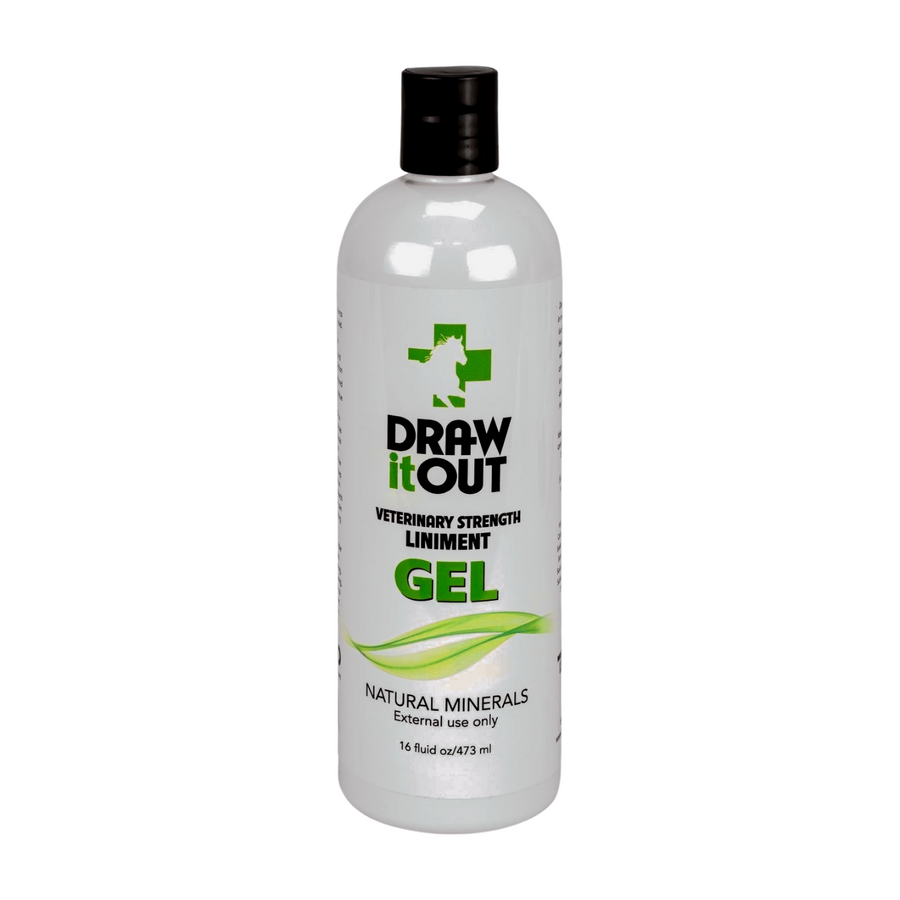
Draw It Out® Liniment Gel is made without menthol, camphor, capsaicin, alcohol, witch hazel, or DMSO. It is odorless and colorless, which makes it easier to keep the focus on application and observation rather than sensory drama.
Gel, spray, or concentrate?
| Format | Best fit | Tradeoff |
|---|---|---|
| Ready-to-use gel | Targeted placement on specific muscle groups or legs. | Takes more hands-on application when covering large areas. |
| Ready-to-use spray | Fast, broad application when a no-mix format is available. | Less precise than gel and easier to overspray. |
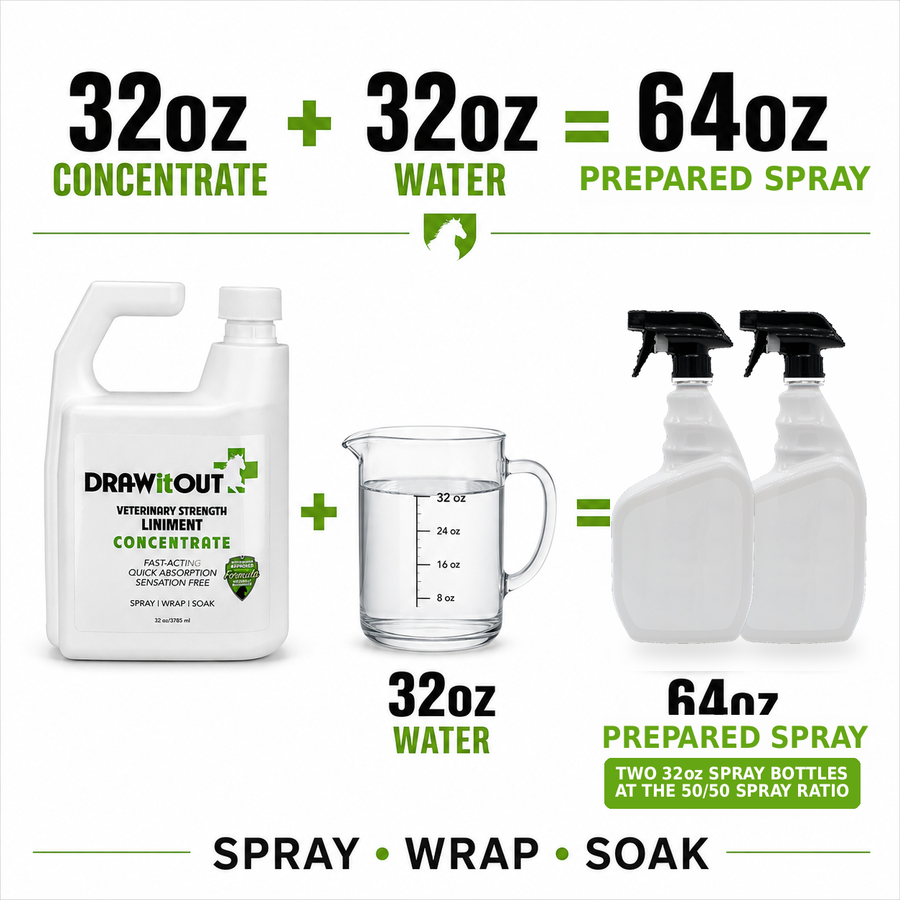
| Concentrate | Multi-horse barns, wash-rack routines, sponge application, or refill systems. | Requires correct measuring, mixing, labeling, and storage. |
The correct format is the one that removes friction from the routine without encouraging careless use. For most riders choosing a first daily-use bottle, a ready-to-use gel is the simplest starting point.
A five-minute daily liniment routine
- Observe before touching. Watch the horse stand, walk, and turn. Note willingness and symmetry.
- Use both hands. Compare matching areas left to right for temperature, filling, sensitivity, and texture.
- Decide whether product belongs. If you find an unexplained change, significant heat, marked swelling, lameness, or worsening discomfort, stop and get the appropriate professional involved.
- Apply according to the label. Use the amount and placement the product calls for. More is not automatically better.
- Check tomorrow. The next-day comparison is often more useful than the immediate post-application impression.
One straightforward starting point
Draw It Out® 16oz Liniment Gel is the flagship ready-to-use option for targeted daily horse care. It is odorless, colorless, sensation-free, and designed for riders who want placement without the harsh old-school profile.
See the 16oz Liniment GelUse the Solution FinderWhen liniment is not the next step
Do not use routine care to talk yourself out of an important finding. Contact your veterinarian promptly for severe or increasing lameness, significant heat or swelling, an open injury that needs evaluation, fever, unwillingness to bear weight, neurological signs, sudden behavior change, or anything that feels outside your horse’s normal pattern. Farrier and saddle-fit problems also need the right professional rather than another layer of topical product.
Daily-use horse liniment FAQ
Can horse liniment be used every day?
Some products are designed to fit frequent routines, but the label controls. Reassess the horse each day and follow the specific product’s directions rather than assuming every liniment can be used the same way.
Does a liniment need menthol to work?
No sensory ingredient alone proves that a product is a better fit. Evaluate the whole formula, label, application, and horse’s response. Draw It Out® provides a menthol-free lane for riders who do not want cooling sensation or strong fragrance.
Should I choose gel or concentrate?
Choose gel for ready-to-use targeted placement. Choose concentrate when mixing and broader barn coverage make operational sense. Measure concentrate precisely and follow its label.
Can I put liniment under wraps?
Only when the product label specifically allows that use. Covering a topical can intensify some formulas. Never assume two products behave the same under wraps, boots, pads, or other equipment.
What should I check before applying liniment?
Check movement, heat, filling, tenderness, symmetry, skin condition, and behavior. If the finding is significant, unexplained, or worsening, pause the routine and involve the appropriate professional.
Get the horse-care notes that match the concern
Join the Draw It Out® herd for practical rider-first guidance on stiffness, hauling, skin, hoof care, and recovery routines.
Educational information only. This article does not diagnose or treat a horse and does not replace veterinary advice. Always follow product labels and governing-organization rules applicable to your horse and event.