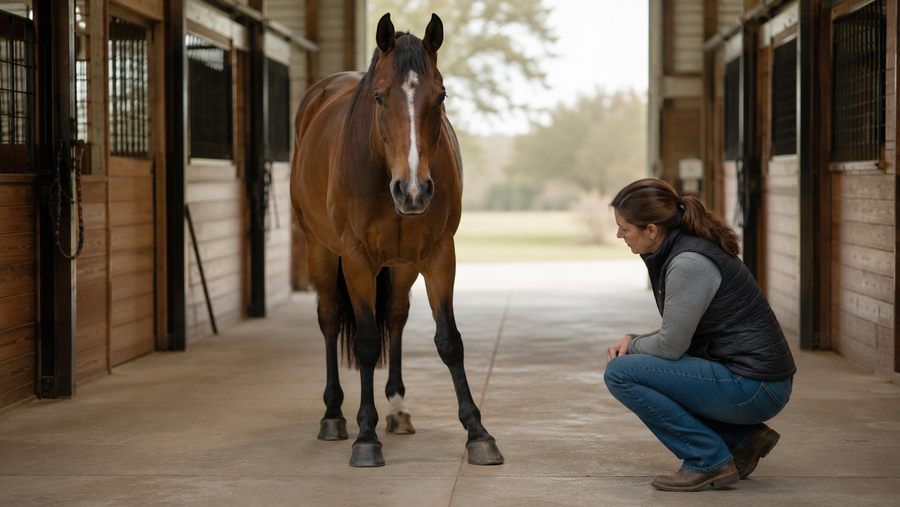
Horse Flinches When Brushed Over the Back: What to Check
A new grooming flinch is information, not attitude. Use this calm checklist to separate skin irritation, pressure sensitivity, tack clues, and veterinary red flags.

Draw It Out® Horse Health Care News
A practical rider-first checklist for finding the attachment site, deciding whether removal is a simple barn task or a veterinary job, and watching the horse afterward without turning a tick bite into a product experiment.
Quick answer: keep the horse still, inspect the location, use gloves, and remove an accessible tick with a proper tick tool or fine-tipped tweezers using steady pressure close to the skin. Call your veterinarian when the tick is in an eye, ear canal, mouth, sensitive tissue, the horse will not stand safely, or the site is already swollen, draining, painful, or damaged. Record the date and location, then watch the horse and the attachment site.
Ticks can be easy to miss under a thick mane, feathering, long summer hair, or a dusty coat. They can also be mistaken for a scab, skin tag, seed, dried mud, or small growth. Do not yank at something until you can see where it meets the skin.
Part the hair with good light. Look for a small body attached at one point, and check whether the area is already rubbed, raw, bleeding, swollen, or crusted. If you are not sure it is a tick, take a clear photo and call your veterinarian before pulling.
Finding one tick should trigger a whole-horse check. Run your hands slowly through the coat and inspect sheltered, warm, thin-skinned areas rather than stopping after the first one.
Before removal
A tick on the eyelid, inside the ear canal, close to the mouth, on genital tissue, or in a location the horse will not let you handle safely belongs with a veterinarian. The same is true when many ticks are clustered together or the skin is already significantly damaged.
For a calm horse and an easy-to-reach tick, position the removal tool as close to the skin and mouthparts as possible without crushing the swollen body. Use slow, steady pressure according to the tool directions. Avoid jerking, squeezing, burning, coating, or aggressively twisting the tick.
If the tick breaks, the mouthparts appear to remain, the area begins bleeding more than expected, or the horse reacts strongly, stop digging at the skin and call your veterinarian. Turning a small attachment site into a deeper wound creates a second problem.
A small local bump can happen after attachment, but the trend matters. The site should not become progressively hotter, more painful, more swollen, foul smelling, or increasingly wet.
Do not wait on a routine product answer when you see a meaningful change. Contact your veterinarian for:
Do not diagnose a tick-borne illness from a photograph or assume that every post-ride problem came from the tick. Your veterinarian can evaluate the whole horse, exposure history, regional risks, and whether testing is appropriate.
Citraquin® Environmental Defense Spray can remain part of a normal, label-directed fly-season and turnout routine on intact skin.
It is not a tick-removal product, wound treatment, disease-prevention product, and it does not eliminate exposure to ticks, flies, mosquitoes, or insect-borne illness. Do not use it to force an attached tick to release, and do not spray it onto open, broken, blistered, or irritated skin unless the label specifically directs otherwise.
The rider-first sequence is simple: inspect the horse, handle the tick correctly, move abnormal skin or whole-horse signs into the veterinary lane, then return to ordinary environmental-defense routines only when the skin is intact and the horse is normal.
Use the Solution Finder or compare the pesticide-free horse spray routine.
Visit the Horse Health Library tick and wound-check route for the broader seasonal pest-pressure lane.
No. Do not experiment with coating, burning, or irritating an attached tick. Use a proper removal tool and veterinarian-directed method.
Ask your veterinarian. A sealed specimen or clear photo, along with the date and exposure location, may help with identification and history.
Do not keep digging. Contact your veterinarian for guidance, especially if the area is sensitive, painful, swollen, or difficult to handle safely.
Citraquin® belongs in a label-directed environmental-defense routine on intact skin. It is not a wound product or tick treatment. Avoid open, broken, blistered, or irritated areas unless the label specifically directs otherwise.
No. A tick finding is an exposure event, not a diagnosis. Record it, monitor the horse, and contact your veterinarian if the horse or attachment site changes.
Educational support only. This article does not replace veterinary diagnosis, treatment, parasite-control planning, or emergency care. Follow product labels and contact your veterinarian for embedded parasites, wounds, fever, swelling, drainage, pain, lameness, weakness, poor coordination, or sudden behavior changes.
A new grooming flinch is information, not attitude. Use this calm checklist to separate skin irritation, pressure sensitivity, tack clues, and veterinary red flags.
Learn how horse fly spray ingredients work, why mode of action differs from real-world performance, and how Citraquin® fits a label-first routine.
A horse that repeatedly points one front foot is giving you useful information. Compare stance, hoof heat, digital pulse, movement, and red flags before you ride or apply...
!