
Quick answer: If a horse is short-strided after deep footing, stop hard work and compare feet, shoes, legs, tendons, back, posture, and movement on safe level ground. Deep footing increases effort, but do not assume simple fatigue. Call the veterinarian for lameness, pain, heat, swelling, tendon sensitivity, weakness, or a stride that persists or worsens.
Deep footing asks the horse to push through and lift out of the surface on every step. Speed, turns, jumps, repeated transitions, and fatigue can increase the cost. The ride may feel ordinary while the horse does substantially more work.
Describe the Movement
Is the stride short in front, behind, or both? Is the horse uneven or simply taking smaller steps? Does the pattern appear immediately, after rest, or only on a particular surface? Watch a few straight steps on level, non-slip ground if the horse can move safely.
Circles add load and can worsen a problem that is already visible.
Check Feet and Shoes
Pick out all four feet. Look for packed material, stones, hoof-wall damage, loose or shifted shoes, unusual heat, and stronger digital pulses than normal. Deep footing can also hide surface irregularities and make the horse work harder to stabilize.
Compare Legs and Soft Tissues
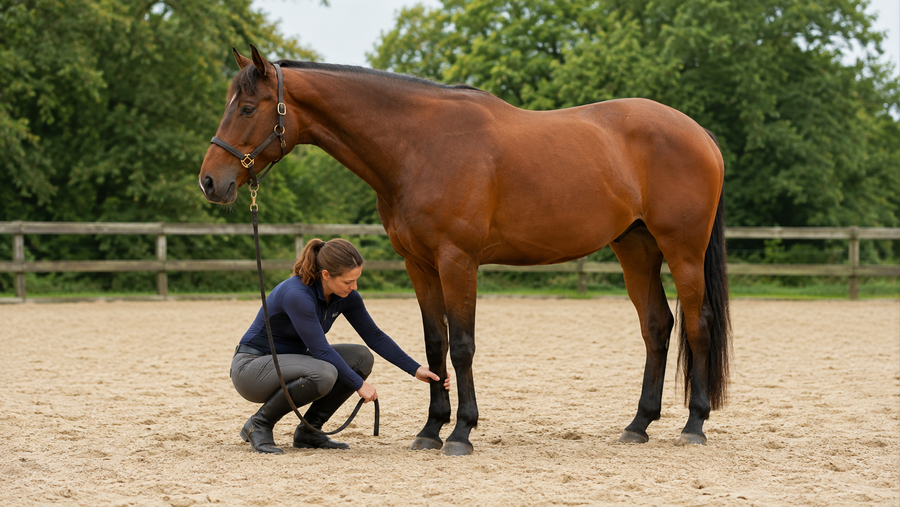
Use light, consistent touch to compare matching structures. Look for heat, swelling, filling, wounds, or sensitivity along the lower legs. Do not apply deep pressure to tendons or repeatedly flex a painful limb.
Check the Back and Whole Horse
Deep footing affects more than the lower legs. Notice back, shoulder, hindquarter, and girth-area sensitivity, plus breathing, sweat, attitude, appetite, and recovery. Fatigue can alter coordination and increase strain throughout the body.
Review the Actual Workload
- How deep and loose was the footing?
- Did depth vary across the arena?
- How much speed, turning, jumping, or collection occurred?
- Was the horse already tired from travel or previous work?
- Did heat or humidity slow recovery?
Do not calculate workload from minutes alone.
Plan the Next Ride
If the horse is abnormal, stop and get professional guidance. If the horse returns fully to normal without red flags, reduce the next workload and avoid repeating deep footing immediately. Record the pattern. Recurring short movement after the same surface deserves evaluation.
Where Draw It Out® Fits
Draw It Out® 16oz Liniment Gel may fit a familiar, label-directed external post-work routine for an appropriate horse. It does not diagnose short movement or replace rest, veterinary care, farrier care, or footing changes.
FAQ
Can deep footing make a horse sore?
It can increase effort and fatigue, but pain and short movement should be assessed rather than automatically attributed to the surface.
Should I walk the horse until the stride improves?
Only use gentle movement when the horse is sound and comfortable. Stop if movement worsens or the horse appears painful.
When should I call the veterinarian?
Call for lameness, pain, heat, swelling, tendon sensitivity, weakness, or a stride that persists or worsens.
General horse-care education only. This article does not diagnose or treat a horse and does not replace veterinary advice.