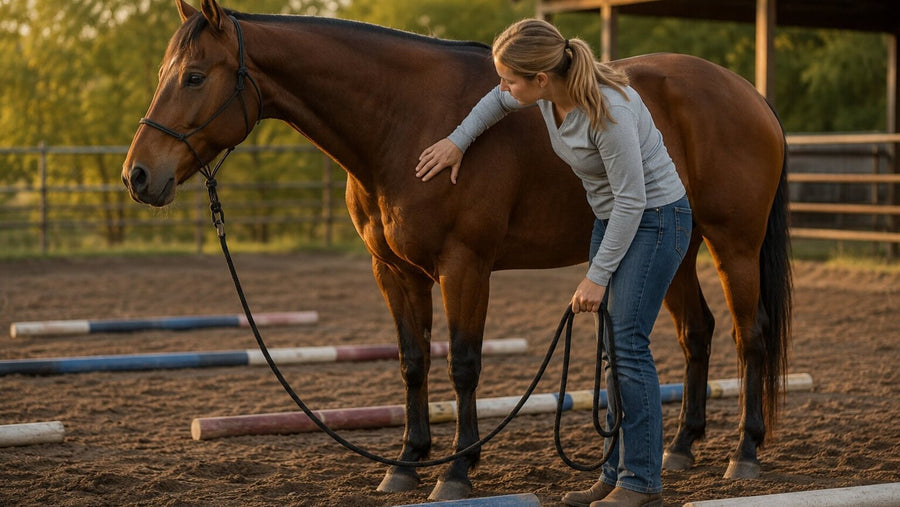
Movement before products
Horse Hind End Weak After a Hard Week? What to Track
Quick answer: A horse that feels weak behind after a hard week needs a workload and movement check before another demanding ride. Compare first steps, straight-line tracking, turns, backing, transitions, feet, legs, back, hydration, appetite, and recovery with the horse’s normal. Do not assume ordinary fatigue when weakness is sudden, one-sided, worsening, painful, or paired with stumbling or incoordination.
“Weak behind” can describe several different rider sensations: less push, trouble stepping under, drifting, difficulty holding a lead, dragging toes, poor transitions, or simply a horse that feels flat after accumulated work. The phrase identifies a change, not a cause.
Start with the previous seven days
Workload
Count the actual effort: hills, deep footing, speed, collection, circles, cattle work, poles, jumps, hauling, turnout changes, and hard consecutive days.
Recovery
Review cool-out time, hydration, appetite, manure, sleep, next-morning movement, and whether the horse returned to its normal baseline.
Feet and legs
Check shoe or trim timing, hoof wear, digital pulse, heat, filling, asymmetry, wounds, and whether one limb lands or loads differently.
Back and tack
Look at grooming response, saddle and pad marks, girth area, topline symmetry, rider balance, and any equipment change.
A safe movement check
- Watch the horse leave the stall or pen. First steps may reveal more than movement after a long warm-up.
- Use a firm, level surface when safe. Observe a straight walk from the side and behind. Compare stride length, tracking, toe drag, hip movement, and willingness.
- Turn both directions. Keep turns controlled and wide enough to remain safe. Note crossing, pivoting, reluctance, or loss of balance.
- Back a few quiet steps. Stop if the horse resists, loses balance, appears painful, or the exercise is unsafe.
- Do not lunge a concerning horse into circles. Circles can add stress and make an unclear problem worse.
Fatigue, soreness, or something more?
Normal post-work fatigue should trend toward the horse’s baseline with appropriate rest and recovery. A horse that remains weak, deteriorates with movement, changes gait, or develops pain needs professional evaluation. Hind-end changes may involve the feet, hocks, stifles, pelvis, back, muscles, nervous system, conditioning, or another area entirely.
Stop riding and call your veterinarian when
- Weakness is sudden, marked, one-sided, or rapidly worsening.
- The horse stumbles, knuckles over, drags a limb, crosses abnormally, or appears uncoordinated.
- There is lameness, significant heat or swelling, trauma, fever, pain, or reluctance to bear weight.
- The horse has abnormal breathing, collapse, colic signs, reduced appetite, or unusual dullness.
- The problem remains after reasonable rest or returns whenever workload increases.
How to plan the next day
Do not let the calendar make the decision. If the horse is sound, comfortable, and improving, quiet turnout or controlled hand-walking may fit the plan. If the horse is not back to baseline, another hard ride is not a fitness solution.
Use the horse not acting normal checklist to review the whole horse. When normal movement is appropriate, the warm-up and cool-down guide can help you keep the next session progressive.
Where routine topical care may fit
After urgent concerns are ruled out and the horse is in the routine-care lane, a label-directed topical can fit a hands-on post-work routine. It does not diagnose hind-end weakness, correct conditioning or tack, or make an unsound horse ready to ride.
Draw It Out® 16oz High Potency Gel is a ready-to-use, stay-put format for targeted application. Use only on clean, dry, intact skin and follow the current label. Check current governing-body rules when competition eligibility matters.
Hind-end weakness FAQ
Can a hard week make a horse feel weak behind?
Accumulated workload and inadequate recovery can affect performance, but weakness should not automatically be labeled fatigue. Compare the whole horse and involve a veterinarian when the change is marked, persistent, painful, or abnormal.
Should I ride to loosen the horse up?
Do not ride through unexplained weakness or altered movement. A short controlled hand walk may provide information when the horse is sound and no red flags are present, but worsening signs require stopping.
Can liniment fix hind-end weakness?
No. A topical may fit ordinary body care after the cause and appropriate activity have been considered. It cannot diagnose or correct weakness.
Bottom line
Weak behind is information, not an invitation to push harder. Track the workload, watch the movement, respect neurological and lameness red flags, and let the horse’s recovery determine what happens next.