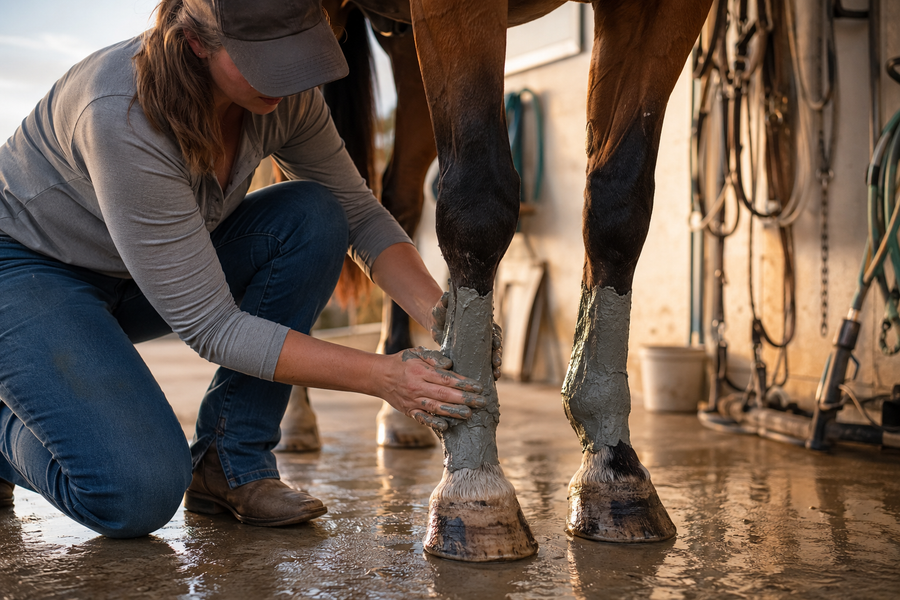
Quick answer: Before wrapping a horse’s leg, check the leg with your hands and eyes first. Compare both sides, note heat, swelling, tenderness, skin condition, and how the horse is moving. A wrap should support an appropriate routine—not cover up a problem you have not identified.
Horse leg wrapping is common in working barns, but the order matters. Observe first. Decide whether the leg belongs in a routine-care lane or a professional-care lane. Then wrap only when the horse, skin, materials, and purpose all make sense.
Start with the unwrapped leg
Use the opposite leg as your comparison. Run your hands down the same structures on both sides and look for differences in temperature, filling, sensitivity, cuts, rubs, drainage, or shape. Watch the horse walk if the situation is unclear.
Do not assume every puffy leg is “just stocking up,” and do not assume a standing wrap is automatically harmless. New one-sided swelling, marked heat, pain, a wound, sudden lameness, or a strong change from the horse’s normal baseline deserves more attention before anything is covered.
When not to wrap first
- New or rapidly increasing swelling.
- Heat that is clearly different from the opposite leg.
- Pain or a strong withdrawal response.
- Lameness or an obvious change in gait.
- Open wounds, drainage, punctures, or damaged skin unless your veterinarian has given specific bandaging instructions.
- Possible tendon, ligament, hoof, or infection-related problems.
If you are unsure what you are feeling, stop and involve your veterinarian, farrier, or another qualified professional rather than using a wrap to buy time.
Safer standing-wrap basics
When wrapping is appropriate, use clean, dry materials and even pressure. The padding layer should lie flat without wrinkles, and the outer bandage should be snug enough to stay in place without creating tight bands or pressure points.
- Wrap clean, dry legs.
- Keep tension consistent from top to bottom.
- Avoid wrinkles and bunching in the padding.
- Do not let the bandage migrate or sag.
- Recheck the leg and wrap after application.
- Remove the wrap if the horse becomes uncomfortable or the leg changes.
Topicals under wraps: read the label, not the folklore
Some topicals are not appropriate under wraps because occlusion can change how they behave on the skin. Always follow the current product label rather than assuming a liniment, clay, or cream is wrap-safe.
If you want a ready-to-use liniment gel specifically designed to fit routine use under properly fitted wraps, the current in-stock option is Draw It Out® 16oz Liniment Gel. Use only as directed, on appropriate skin, and never as a substitute for evaluating new heat, swelling, pain, or lameness.
Build a repeatable leg-check routine
- Look: compare shape, swelling, skin, and stance.
- Feel: compare temperature and tissue response side to side.
- Move: watch the horse walk if anything seems different.
- Decide: routine care, monitor, or call a professional.
- Wrap only if appropriate: then check the wrap and horse again.
The best wrapping routine is not the fanciest one. It is the one that keeps the rider paying attention to the horse instead of treating the bandage itself as proof that something useful was done.
Related horse-care guides
For more detail, see the liniment-under-wraps guide, the horse leg anatomy guide, and the Draw It Out® safety guide.
Frequently asked questions
Can I wrap a stocked-up horse leg?
Sometimes, but confirm that the filling matches the horse’s normal pattern and is not accompanied by heat, pain, lameness, a wound, or a one-sided change that needs professional evaluation.
Should I put liniment under a standing wrap?
Only if the product label allows it and the leg and skin are appropriate for routine care. Do not assume all liniments are safe under occlusion.
How tight should a standing wrap be?
It should be secure and even without creating tight ridges, pressure points, or slipping. If you have not been taught to wrap correctly, ask an experienced professional to show you in person.
When should I call the veterinarian instead of wrapping?
Call for marked heat, significant or rapidly increasing swelling, pain, lameness, wounds, drainage, fever, suspected infection, or any change that is unusual for that horse.