THE HORSE IN FRONT OF YOU SETS THE STANDARD.
Late-Summer Fly Control for Horses: Fix the Gaps in Your Routine
By Jon Conklin, founder of Draw It Out® · September 14, 2026
Updated September 30, 2026: Expanded with a label-first explanation of ingredient mechanisms and complete-formula decisions.
What should you do when flies keep bothering your horse late in the season? Identify the pressure, check the environment, follow the spray label, and review what happens during your actual turnout schedule. Build each step around a specific job.
September hands you shorter evenings and the same barn chores. You have already bought spray, washed masks, and spent a summer trying to give your horse some peace.
When the tail keeps working harder than the horse, another promising bottle can be tempting. Before you spend again, make the next decision count. Figure out where the current routine is falling short.
What Absorbine’s new article actually says
In its September 14 article, The Second Fly Season: Late Summer Fly Control Tips, Absorbine explains that insect activity can continue into fall. It recommends consistent environmental management and direct protection, then introduces UltraShield® Gold’s FlyShield® Technology as a way to interfere with insects’ ability to locate the horse.
On September 30, Absorbine followed with How Absorbine FlyShield® Technology Works. The company identifies octanoic acid, nonanoic acid, and decanoic acid as the fatty-acid blend used to disrupt insects’ scent-based homing. It also explains that UltraShield® Gold combines those fatty acids with permethrin, pyrethrins, and piperonyl butoxide, ingredients assigned different jobs inside the complete formula.
The mechanism is useful information. Our next question is practical: What does that explanation tell a rider, and what must the rider still verify before choosing the bottle?
Mode of action is not the same as real-world protection
Does knowing how one fly-spray ingredient works tell you which product to buy? No. A mode of action explains a biological mechanism. It does not, by itself, establish the complete formula, labeled uses, application restrictions, practical duration, or fit for your horse and barn.
Marketing often puts the most interesting ingredient or technology at center stage. Riders still need to evaluate four separate layers:
- The ingredient mechanism: What is the ingredient described as doing to the insect?
- The complete formula: What other active and supporting ingredients are present?
- The product label: Which animals, insects, application sites, precautions, and directions are actually listed?
- The barn conditions: How do sweat, rain, bathing, coat condition, turnout, and insect pressure affect the routine?
This matters when a formula combines plant-based ingredients with conventional insecticide actives. “Plant-based ingredients” can accurately describe part of a formula without describing the entire product. Read the full label before treating an ingredient story as a category claim.
Find the gap before changing the bottle
Different insects call for different management. University of Minnesota Extension explains that stable and house flies develop in moist organic material, while mosquitoes develop in standing water. Horse and deer flies can arrive from wetland areas beyond your property. Its guidance also distinguishes between traps: baited house-fly traps do not control stable flies. Read the Extension guide to common flies around horses.
| If the problem is | Check this part of the plan |
|---|---|
| Biting stable flies | Wet feed debris, soiled bedding, manure, and muck near leaking waterers. Match traps and physical protection to the insect. |
| Mosquitoes | Water-holding containers and trough maintenance. Discuss mosquito-borne disease vaccination with your veterinarian. |
| Horse or deer flies | Access to suitable shelter during daytime activity. A clean stall alone cannot remove off-site breeding areas. |
These distinctions matter because the money follows the diagnosis of the problem. A trap full of one kind of fly does not prove you have addressed the insect bothering your horse.
Make every spray earn its place
A named technology deserves a clear explanation. A naturally derived formula deserves the same scrutiny. For any product you are considering, ask these five questions:
- What does the current label actually claim? Look for the intended use and named insects. Separate a description of how something works from the results you can reasonably expect.
- Where and how can I apply it? Check the permitted application sites, amount, precautions, and instructions before building your routine around it.
- What happens on our kind of day? Ask how the directions account for rain, bathing, sweat, and the conditions your horse encounters.
- What evidence supports the claim I care about? A useful comparison identifies the product tested, conditions, measured outcome, and duration. A headline alone cannot answer all four.
- Can our barn follow the directions consistently? Decide who applies it, who checks the horse, and who records when another application is allowed. A routine has to survive a busy Tuesday.
Keep a short note: product, application time, weather, turnout location, and what you observed. Use it to ask better questions and spot patterns. It is a management record, not a controlled trial or proof that one formula beats another.
Where Citraquin® fits
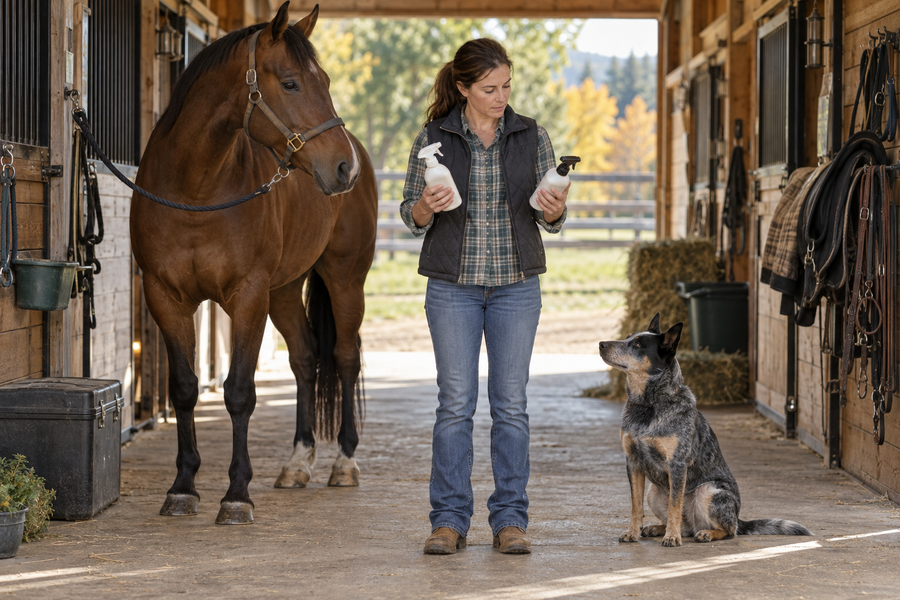
Citraquin® Environmental Defense Spray is our ready-to-use, pesticide-free horse-spray option for an established fly-season routine. Choose the 32oz format when getting familiar with the product; the 128oz refill fits regular users.
Prepare the coat, shake before use, and follow the current label. Avoid eyes, nose, mouth, and broken or irritated skin. Rain, sweat, bathing, and insect pressure can change the practical reapplication needs. There is no fixed-duration promise that applies to every barn.
Choose by the complete product, its directions, and how it fits your horse. For riders who want a pesticide-free spray step they can work into regular care, Citraquin® gives that choice a clear place in the barn.
The Citraquin® routine guide explains application expectations, format choices, and sensitive-skin considerations.
Give the routine an owner
A useful late-season reset can start with three assignments:
- One person walks the problem areas. Write down what needs attention and when it will be handled.
- One person checks the instructions. Keep the current product directions where the people doing the work can find them.
- One person closes the loop. Review the horse’s response and the day’s conditions before deciding what to change.
In a one-person barn, that person is you. Put the note beside the feed chart so the decision is waiting when you get there.
When rubbing has progressed to raw skin, swelling, or persistent irritation, get veterinary guidance before adding more products. Citraquin® is not a treatment for sweet itch or a substitute for veterinary disease prevention.
Horse fly-spray questions riders should ask
Do plant-based fly-spray ingredients make the entire formula pesticide-free?
No. A product may contain plant-based ingredients while the complete formula also contains pesticide active ingredients. Absorbine’s explanation places its three fatty acids inside an UltraShield® Gold formula that also includes permethrin and pyrethrins, with piperonyl butoxide serving as a synergist. Evaluate the complete formula and current label, not one ingredient group or headline.
What is the difference between a mode of action and expected performance?
A mode of action explains how an ingredient is intended to affect or deter an insect. Expected performance is a broader product question involving the complete formula, labeled insects, application directions, testing conditions, weather, sweat, bathing, and reapplication instructions.
Where does Citraquin® fit in that comparison?
Citraquin® occupies a different product lane. It is positioned as a pesticide-free environmental defense spray used as directed within a broader horse-care and barn-management routine. It does not carry a fixed-duration guarantee and should not be treated as disease prevention or a substitute for veterinary guidance.
Build a routine you can stand behind
At Draw It Out®, we believe a horse-care company should help you make a sound decision about the next bottle. Sometimes that decision starts with a better question, a repaired waterer, or a clearer job for everyone in the barn.
Innovation earns its place when the explanation is clear and the routine makes sense. Your horse deserves that standard every day the insects are still showing up.
Explore Citraquin® and current availability
Be your horse’s hero, we’ll help you do it.