


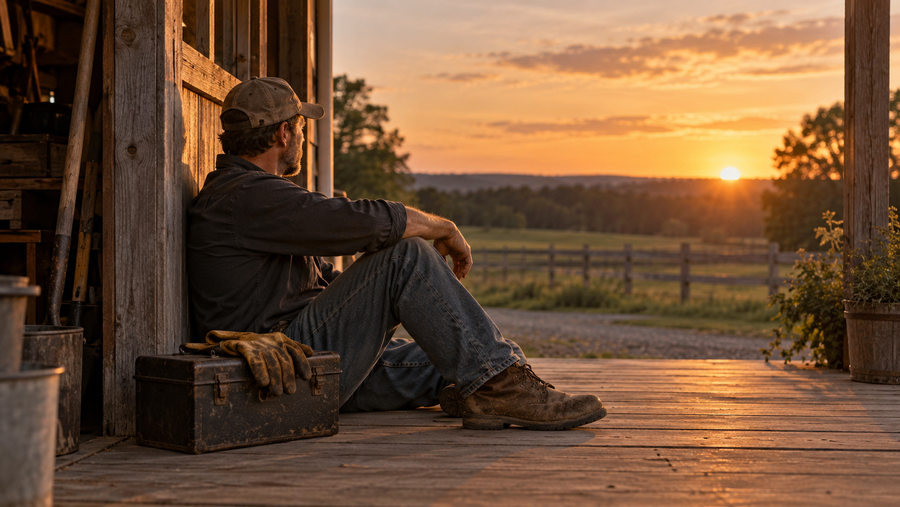
Labor Day Is Also Permission to Rest
A Labor Day reflection for the people who carry the load all year: honest work deserves respect, and the worker deserves a moment to set it down.
Free U.S. shipping at $50+
No code needed.
Shipping details
Twenty-five years is enough time for a child to become an adult. It is enough time for skylines to change, memorials to rise, and an entire generation to learn about September 11, 2001 as history.
It is not enough time to make the loss small.
For the families of those killed, for survivors, and for responders and recovery workers, the distance between then and now is not measured only in years. Grief does not follow a schedule. Recovery does not mean forgetting. Moving forward does not require leaving the past behind.
Recovery is not a clean return to the person or the world that existed before. Some events change the shape of everything that follows. The work is not to erase the wound. It is to learn how to carry truth, sorrow, love, and responsibility together.
That is why anniversaries matter. They make space for names that should still be spoken. They remind us that private grief continues after public attention moves on. They call us to stand beside people without trying to hurry their healing or explain their pain.
At the National September 11 Memorial stands a Callery pear known as the Survivor Tree. It was found severely damaged at Ground Zero in October 2001, with broken branches and snapped roots. It was removed, cared for, and returned to the Memorial in 2010.
Its old, scarred trunk and newer growth remain visible together. The past was not hidden so the tree could appear untouched. Its survival is powerful precisely because the damage can still be seen.
The story of the Survivor Tree has become a living symbol of endurance and renewal. It does not suggest that tragedy was somehow necessary. It shows that life can continue without denying what happened.
On September 11, courage appeared in countless forms. It was the first responder entering danger. It was the passenger making a final call. It was the stranger helping another stranger down a stairwell. It was the family member who carried unbearable news. It was the recovery worker who returned day after day.
In the years since, courage has also looked quieter. It has looked like keeping an appointment, speaking a name, asking for help, telling a child the truth, attending another memorial, and waking up to face another September morning.
There is no single right way to mark this day. Some gather. Some serve. Some pray. Some lower a flag. Some sit in silence. Respect begins with allowing grief to be what it is.
Twenty-five years later, we remember the nearly 3,000 people who were killed. We honor the families whose lives were divided into before and after. We thank the responders, service members, medical teams, recovery workers, and volunteers whose service continued long beyond that morning.
We also remember the obligation passed to us: to tell the truth, to reject indifference, to care for one another, and to keep memory alive for those who come next.
What was lost cannot be replaced. What was given in courage and love must not be forgotten.
A Labor Day reflection for the people who carry the load all year: honest work deserves respect, and the worker deserves a moment to set it down.
Calf tightness after riding is often a workload or position clue. Review stirrup length, gripping, boots, hydration, recovery, and medical red flags first.
A practical rider overnight packing guide with a human-care checklist, current ReJüv™ package roles, travel boundaries, and label-first use guidance.
!

