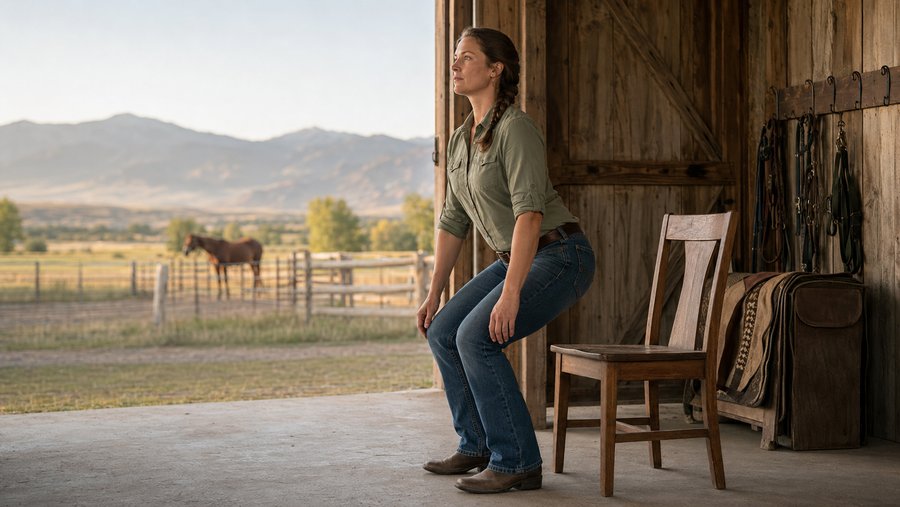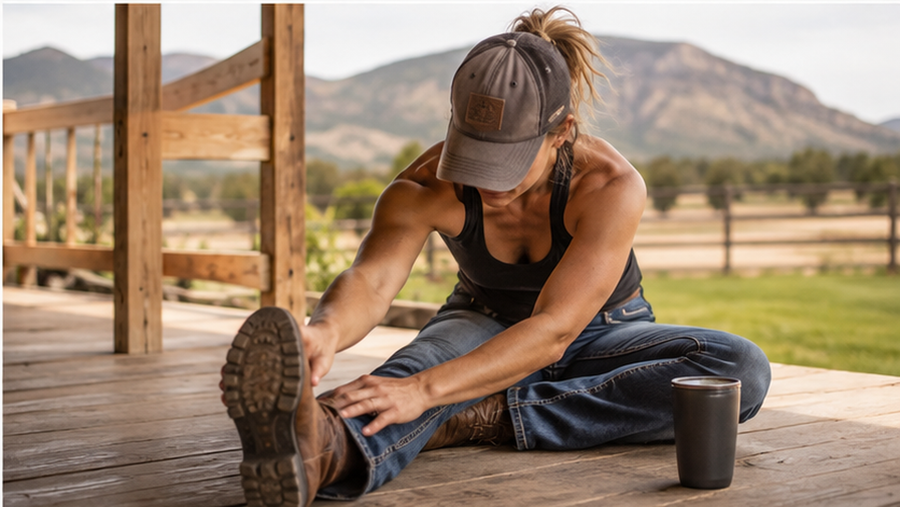
Rider taking a quiet recovery pause beside her settled horse in a barn

ReJüv™ Recovery Journal

Why Riders Ignore Their Own Recovery and How to Fix It

Quick answer

Riders often skip their own recovery because horse care is urgent, visible, and scheduled while human fatigue is private and easy to postpone. Fix the pattern with a two-minute minimum attached to a reliable handoff: once the horse is secure, drink, walk, scan, move, and record before the truck starts or the next obligation takes over.

Why do riders ignore their own recovery?

Horse care is concrete. The horse needs water, feed, legs checked, tack cleaned, and a plan for tomorrow. Your own fatigue is easier to negotiate with. You can call it normal, promise to deal with it later, and keep moving.

That is not automatically a character flaw. It is often a system failure. The horse's needs are visible and externally accountable. Human recovery is private, delayed, and placed at the end of a list that rarely ends.

NIOSH treats fatiguing workload, repetition, low job control, awkward posture, carrying, and long exposure as relevant work-design factors. Barn life can combine several of them before the rider even gets in the saddle. Review the NIOSH ergonomics guide.

What do rider conversations reveal about the real problem?

Public horse forums repeatedly separate the ride from the labor around it. Riders discuss wheelbarrows, hay nets, water buckets, sweeping, mucking, driving, and repeated carrying as the harder part of the day. They also trade practical adaptations such as splitting loads, using carts, alternating sides, changing tools, and asking for help.

Those conversations are qualitative, not demand-volume data. They are still useful because they reveal the language and constraints riders use. See the Chronicle of the Horse barn-work discussion and the Horse & Hound rider-and-chores discussion.

What is the rider recovery friction audit?

Before adding another ideal routine, find the point where the current one fails. Use five questions:

  1. Cue: What exact event means essential horse care is complete?
  2. Location: Where are water, clean clothes, a chair or wall, and any human recovery supplies?
  3. Duration: What can you still do when only two minutes are available?
  4. Decision: Which symptoms mean change the task, and which mean stop and seek care?
  5. Feedback: Where will you record one sentence about what felt different?

If the answer to each question requires new motivation, the system has too much friction. Put water where the truck is parked. Clear one small mobility space. Keep the human-labeled product where the human changes clothes, not mixed into the horse kit.

What is the minimum viable recovery routine?

1. Drink
Water before the drive home.
2. Walk
Two easy minutes after untacking.
3. Scan
Hands, shoulders, back, hips, knees.
4. Move
One comfortable mobility sequence.
5. Record
One sentence about what changed.

This is not the ideal routine. It is the floor that keeps the habit alive. Once it is automatic, add sleep protection, food planning, strength work, equipment changes, workload changes, or professional care as needed.

What is the 2, 5, and 15-minute recovery ladder?

Time available Protect this Do this
Two minutes The minimum Drink water, walk slowly, open the hands, lower the shoulders, and name anything meaningfully different
Five minutes The workday reset Add comfortable hip and ankle movement, remove damp clothing, and clean sweat or dirt from the skin
Fifteen minutes The full handoff Use the post-ride recovery routine or 10-minute mobility routine, eat normally, and record tomorrow's adjustment

How does the horse-first handoff rule work?

  1. Name the handoff. Choose one reliable event: the horse is watered, the stall is secure, the trailer is parked, or the tack is put away.
  2. Stage the human step. Put water, a snack, clean clothes, and any human-labeled topical where the handoff happens.
  3. Protect the two-minute floor. Complete it before messages, the truck, or one more optional barn job.
  4. Scale only when useful. Move to five or fifteen minutes when workload, heat, travel, or tomorrow's ride justifies it.

Do not ask riders to care less about the horse. Attach human recovery to the moment horse care changes from urgent to complete.

What is the difference between grit and neglect?

Grit serves the mission. Neglect quietly degrades the person carrying it. Finishing an unavoidable hard day can be grit. Repeating the same preventable overload without changing tools, task order, help, sleep, or workload is not a badge of toughness.

The rider, parent, trainer, ranch hand, or business owner is part of the operating system. Maintenance protects the work, the animals, and the people who rely on them.

Where does ReJüv™ fit without becoming the whole routine?

ReJüv™ is a human-labeled topical wellness gel. It can occupy one small place in the system after the skin is clean, dry, and intact. It does not replace movement, hydration, food, sleep, safer mechanics, workload changes, or medical care.

Follow the current label, apply a thin layer, let it dry, avoid eyes, mouth, broken skin, external heat, tight occlusion, and improvised topical combinations, and discontinue if irritation occurs. Use the before-and-after application guide for the full routine.

ReJüv™ is for people. Draw It Out® Liniment is for horses. K9 Advanced™ is for dogs.

Shop ReJüv™ 8oz EZ Squeeze Gel

When should a rider stop self-managing?

Seek medical guidance for symptoms after a fall or impact, severe or worsening pain, marked swelling, visible deformity, new weakness or numbness, inability to bear weight, chest pain, trouble breathing, fever, a spreading skin reaction, or symptoms that repeatedly change how you ride, walk, lift, sleep, or work.

Do not let the recovery ritual become another way to delay an evaluation you already know you need.

Frequently asked questions

Why do riders take better care of their horses than themselves?
Horse care has visible routines, external accountability, and immediate consequences. Human recovery is easier to postpone because the cost often arrives later.
Is soreness just part of riding?
Some temporary fatigue can follow unfamiliar or demanding activity, but severe, worsening, traumatic, or function-changing symptoms should not be normalized.
How can I build a recovery habit when I have no time?
Attach a two-minute minimum to an existing cue: once the horse is secure, drink water, walk, scan five body areas, and complete one comfortable movement.
Can a topical gel solve poor recovery habits?
No. A topical gel can support a routine, but it cannot replace sleep, conditioning, gradual workload, hydration, nutrition, safer mechanics, or medical care.

Safety note: This article is educational and is not a substitute for professional medical care. ReJüv™ is a human-labeled topical wellness gel for external use. It is not intended to diagnose, treat, cure, or prevent disease or injury. Follow the current label, use only on clean, dry, intact skin, avoid eyes, mouth, broken skin, external heat, and improvised topical combinations, patch-test sensitive skin, discontinue if irritation occurs, and seek care for severe, sudden, traumatic, unexplained, persistent, or worsening symptoms.

Leave a comment

Please note, comments need to be approved before they are published.

Start here

Reading first? Here is the clean path.

This article gives you the background. If you are ready to put the idea into a real horse care routine, these are the next places most riders should go.

Daily recovery

Liniment Gels

Explore the Draw It Out® liniment gel lineup for everyday use, post-work routines, and targeted recovery support.

Shop liniment gels
Find the fit

Solution Finder

Match your horse’s workload, age, routine, and care goals to the Draw It Out® products that make the most sense.

Use the finder
Routine first

Prehabilitation

Learn how riders support soundness, comfort, and consistency before little issues become bigger problems.

Read the guide
Simple rule: read the article for context, use the Solution Finder for direction, then build the routine around the product format your horse will actually use consistently.

Real Barn Proof

What this looks like in real barns.

Real riders. Real horses. Real routines. These clips rotate automatically so the proof stays fresh without weighing the page down with a long feed.

Random rider clips

Why this matters: good horse care should make sense outside the ad. These clips show the kind of everyday use that builds trust one barn at a time.

Further Reading

Keep building the routine.

Horse care works better when the next step is clear. These related reads help connect today’s topic to better daily decisions in the barn.

Horse health news

Start with the principle, then build the habit. The right article should make the next barn decision easier, not more complicated.

Next Step

Keep your barn dialed in.

Simple care guides, practical product paths, and rider-trusted tools built for real horses and real routines.

Good care gets easier when the next step is obvious. Read the guide, match the routine, then choose the format that fits how your barn actually works.

Recovery Routine

Build a complete recovery routine.

Want a smarter way to think through post-ride care, heat, swelling, leg support, and daily recovery decisions? Start with the Performance Recovery Hub.

Better recovery starts with a repeatable routine. The hub gives riders a clearer path from workload to product format to aftercare timing.

Rider Favorites

Always in the kit.

Four core Draw It Out® staples riders keep close for daily recovery routines, wash rack use, targeted support, and quick barn-side care.

Core barn staples
Draw It Out® 16oz Liniment Gel | Daily Horse Care

Stay-Put Gel

16oz Liniment Gel

The everyday liniment gel format riders reach for when they want targeted, no-mess application.

View product
Draw It Out® 32oz Horse Liniment Concentrate | Spray, Wrap & Soak

Mix Your Way

32oz Concentrate

A flexible concentrate for riders who want to mix their own routine around workload and barn needs.

View product
Draw It Out® RTU Spray 24oz | Ready-to-Use Liniment Spray

Ready To Use

24oz RTU Spray

A ready-to-use spray format for quick application after work, travel, turnout, or daily care.

View product
CryoSpray® by Draw It Out® 24oz | Cooling Body Brace for Horses

Cooling Brace

CryoSpray

A cooling body brace spray for riders who want a fast, practical option after hard work or hot days.

View product

Format matters. Gel, concentrate, ready-to-use spray, and cooling spray each solve a different barn problem. Pick the one your routine will actually use.

Where To Go Next

Turn the idea into a routine.

If this topic connects to what you are seeing in your horse, these are the three cleanest next steps. Start with direction, then choose the product format that fits the way your barn actually works.

Next steps

Best next move: use the Solution Finder first when the issue is unclear. Go straight to the liniment gel collection when you already know the format you want.