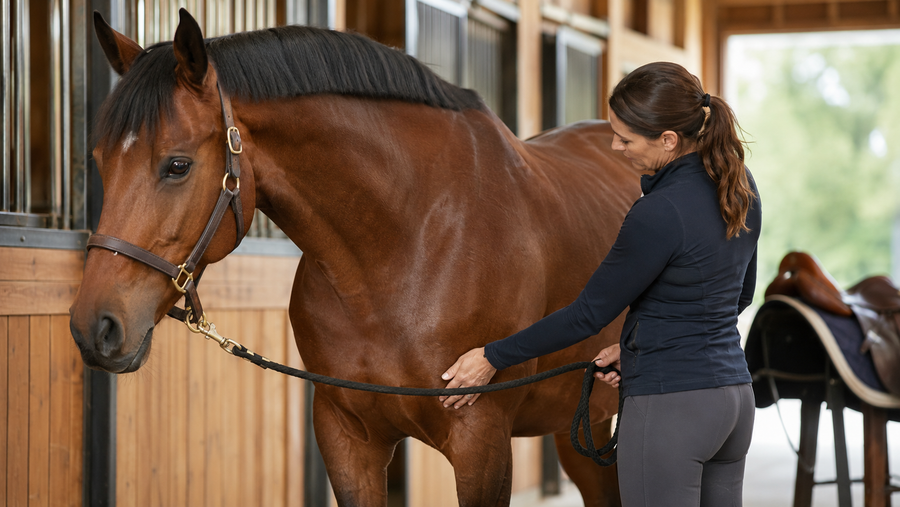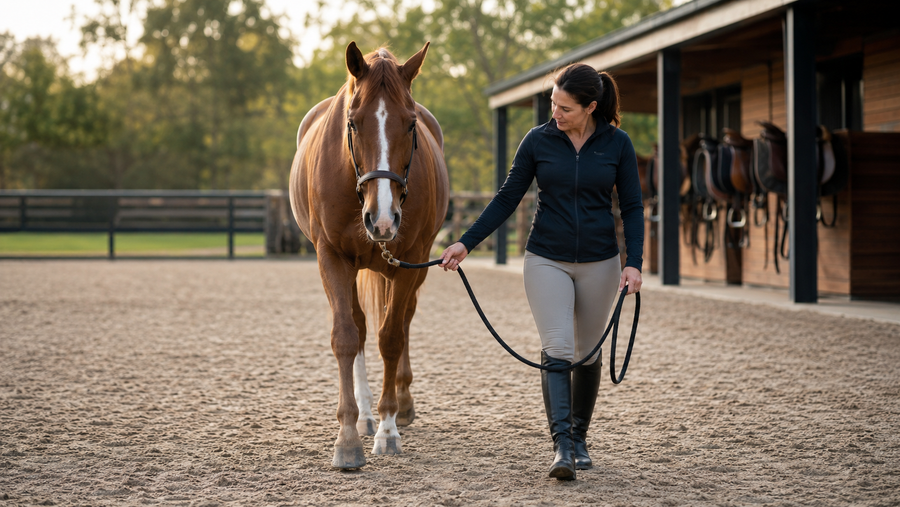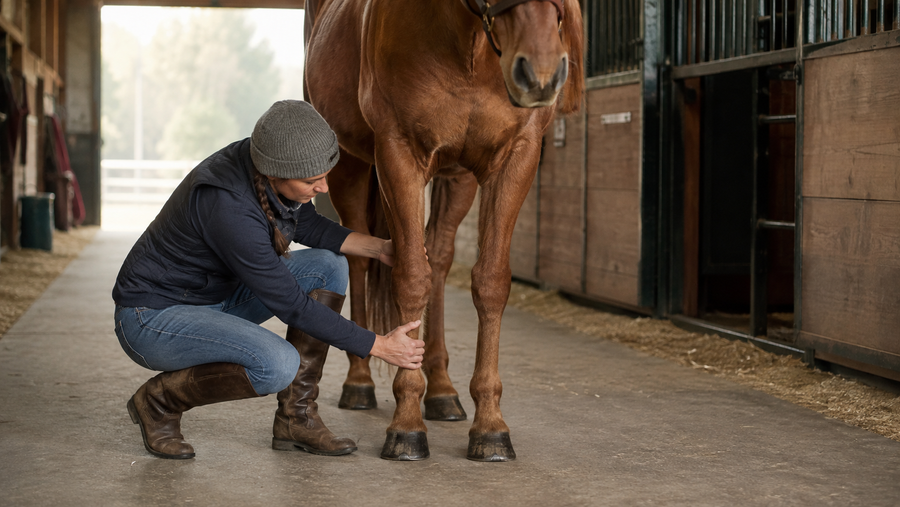
Handler filming a horse trot-up on a straight barn lane

Quick answer: A useful horse trot-up video shows the entire horse at normal speed on level, well-lit footing, moving straight away from and toward a steady camera. Keep every hoof in frame, record several clean passes, and ask your veterinarian which surfaces, gaits, and angles they want. If the horse is markedly lame, unstable, unwilling to bear weight, or unsafe to handle, do not force a trot-up.

Most bad lameness videos are not bad because the phone is old. They are bad because the camera is too close, the horse disappears out of frame, the handler blocks the legs, or the clip begins after the only useful steps.

Your veterinarian does not need cinema. They need clean evidence.

Call or message your veterinarian first when you can

Ask what they want to see. A veterinarian may request walk, trot, a circle, a hard surface, a soft surface, a ridden clip, or a view of a specific transition. Do not add circles, tight turns, flexion, backing, or ridden work on your own if the horse is uncomfortable or the footing is not safe.

A video can preserve a change that disappears at the clinic or only shows after work. It cannot replace palpation, hoof testing, diagnostic analgesia, imaging, or an in-person neurologic and lameness examination.

Set up the shot before you bring out the horse

  • Choose level, non-slippery footing. Avoid deep mud, loose gravel, glare, clutter, and narrow spaces.
  • Use good light. Film with the light on the horse, not directly behind it.
  • Clear a straight lane. Give the horse enough room to establish a normal rhythm before and after passing the camera.
  • Stabilize the phone. A tripod is best. If a person holds it, they should keep both feet planted and avoid walking backward.
  • Film horizontally. Landscape orientation gives the horse room to enter, pass, and leave the frame.
  • Frame the whole horse. Keep the ears, body, all four legs, and every hoof visible.

Safety rule: The camera operator stays out of the travel path. The handler controls the horse. Nobody runs backward in front of a trotting horse to keep the shot centered.

The basic shot list

  1. Standing view. Record ten seconds from each side and from front and behind at a safe distance. Let the horse stand naturally.
  2. Walk away. Start recording before the horse moves. Keep the horse centered until it is well past the camera.
  3. Walk toward. Keep the lead quiet enough for the head and neck to move naturally while maintaining safe control.
  4. Trot away. Use a straight line and keep the entire horse in frame.
  5. Trot toward. The camera stays fixed. The handler passes safely to one side of it.
  6. Side pass-by. Place the camera perpendicular to the lane and record the horse passing from both directions.

Record normal speed first. Slow motion can help later, but a slow-motion-only clip removes timing and rhythm that may matter. Research on remote forelimb-lameness video found that camera angle affects what an observer can detect, with straight-on views providing useful information. See the open-access study on video angle and remote detection of induced forelimb lameness.

What to say with the video

Keep the message short and factual:

  • Date and time recorded
  • Which leg or movement concerns you, if you can tell
  • When it started
  • Whether it appears before work, during work, after work, or after standing
  • Footing shown in the video
  • Recent shoeing, trimming, hauling, hard work, slips, kicks, or falls
  • Any heat, swelling, wounds, fever, or appetite change
  • What products or medications have already been used

A good note sounds like this: “Recorded August 12 at 6:20 p.m. on the packed barn lane. Left hind looks shorter to me after twenty minutes of work. No visible wound. Mild warmth compared with the right. No product or medication applied before this clip.”

Film before you change the picture

If the concern is new and your veterinarian wants to see the untreated movement, record before applying a topical, administering medication, wrapping, icing, or exercising further. Do not delay urgent care for the sake of a video.

After the movement is documented and a professional concern has been ruled out, a normal external-care routine may fit. For targeted, stay-put placement on clean, intact skin, Draw It Out® 16oz Liniment Gel is the ready-to-use format. It is not a diagnostic tool and it does not clear a horse to work.

What ruins an otherwise useful clip

  • Zooming in so tightly that the feet leave the frame
  • Following from directly behind at an unsafe distance
  • Filming only one or two steps
  • Heavy narration over hoof-fall sound
  • Editing several passes into one confusing montage
  • Using filters, portrait blur, or stabilization that distorts movement
  • Sending only slow motion
  • Trotting on footing that changes the horse's gait or risks a slip

When not to trot the horse for a video

Do not force a trot-up when the horse is non-weight-bearing, markedly lame, visibly unstable, severely painful, bleeding, showing signs of fracture, or displaying neurologic-looking movement. Sudden pelvic drift, crossing limbs, falling, or inability to stand normally can have serious causes. UC Davis explains one example in its overview of sidewinder syndrome in horses.

Frequently asked questions

Should I film the horse walking or trotting?

Both are useful in many cases, but ask your veterinarian what they want. Never force a trot from a horse that is unsafe or markedly painful.

Should the camera move with the horse?

Keep it steady for the straight-away and straight-toward views. A fixed frame makes asymmetry easier to compare.

Should I use slow motion?

Record normal speed first. You can include a slow-motion copy, but do not replace the original.

Can a video diagnose lameness?

No. It can document movement and help your veterinarian triage the next step. Diagnosis may require an in-person exam and additional testing.

Should I apply liniment before filming?

When a change is new or unexplained, capture the baseline first if it is safe and your veterinarian has not told you otherwise.

Not sure whether this is a care issue or a professional issue?

The Draw It Out® Solution Finder routes common body, recovery, skin, hoof, grooming, and environmental concerns while keeping veterinary red flags in the professional lane.

Use the Horse Care Solution Finder

Educational horse-care information only. A video does not replace veterinary diagnosis, examination, or treatment.

Leave a comment

Please note, comments need to be approved before they are published.

Start here

Reading first? Here is the clean path.

This article gives you the background. If you are ready to put the idea into a real horse care routine, these are the next places most riders should go.

Daily recovery

Liniment Gels

Explore the Draw It Out® liniment gel lineup for everyday use, post-work routines, and targeted recovery support.

Shop liniment gels
Find the fit

Solution Finder

Match your horse’s workload, age, routine, and care goals to the Draw It Out® products that make the most sense.

Use the finder
Routine first

Prehabilitation

Learn how riders support soundness, comfort, and consistency before little issues become bigger problems.

Read the guide
Simple rule: read the article for context, use the Solution Finder for direction, then build the routine around the product format your horse will actually use consistently.

Real Barn Proof

What this looks like in real barns.

Real riders. Real horses. Real routines. These clips rotate automatically so the proof stays fresh without weighing the page down with a long feed.

Random rider clips

Why this matters: good horse care should make sense outside the ad. These clips show the kind of everyday use that builds trust one barn at a time.

Further Reading

Keep building the routine.

Horse care works better when the next step is clear. These related reads help connect today’s topic to better daily decisions in the barn.

Horse health news

Start with the principle, then build the habit. The right article should make the next barn decision easier, not more complicated.

Next Step

Keep your barn dialed in.

Simple care guides, practical product paths, and rider-trusted tools built for real horses and real routines.

Good care gets easier when the next step is obvious. Read the guide, match the routine, then choose the format that fits how your barn actually works.

Recovery Routine

Build a complete recovery routine.

Want a smarter way to think through post-ride care, heat, swelling, leg support, and daily recovery decisions? Start with the Performance Recovery Hub.

Better recovery starts with a repeatable routine. The hub gives riders a clearer path from workload to product format to aftercare timing.

Rider Favorites

Always in the kit.

Four core Draw It Out® staples riders keep close for daily recovery routines, wash rack use, targeted support, and quick barn-side care.

Core barn staples
Draw It Out® 16oz Liniment Gel | Daily Horse Care

Stay-Put Gel

16oz Liniment Gel

The everyday liniment gel format riders reach for when they want targeted, no-mess application.

View product
Draw It Out® 32oz Horse Liniment Concentrate | Spray, Wrap & Soak

Mix Your Way

32oz Concentrate

A flexible concentrate for riders who want to mix their own routine around workload and barn needs.

View product
Draw It Out® RTU Spray 24oz | Ready-to-Use Liniment Spray

Ready To Use

24oz RTU Spray

A ready-to-use spray format for quick application after work, travel, turnout, or daily care.

View product
CryoSpray® by Draw It Out® 24oz | Cooling Body Brace for Horses

Cooling Brace

CryoSpray

A cooling body brace spray for riders who want a fast, practical option after hard work or hot days.

View product

Format matters. Gel, concentrate, ready-to-use spray, and cooling spray each solve a different barn problem. Pick the one your routine will actually use.

Where To Go Next

Turn the idea into a routine.

If this topic connects to what you are seeing in your horse, these are the three cleanest next steps. Start with direction, then choose the product format that fits the way your barn actually works.

Next steps

Best next move: use the Solution Finder first when the issue is unclear. Go straight to the liniment gel collection when you already know the format you want.