ReJüv™ Recovery Journal
Why Do My Hips and Knees Feel Stiff After Riding?
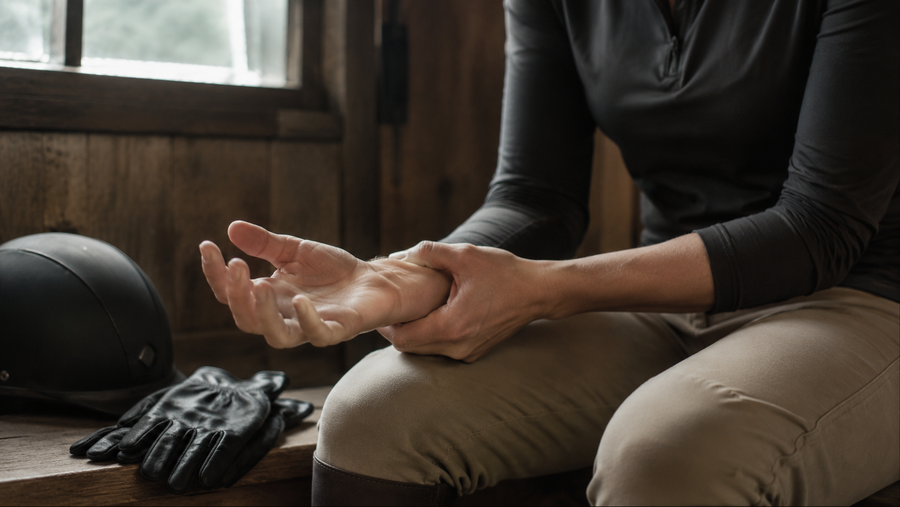
A horse can finish the ride ready for supper while the rider gets out of the saddle like an old pocketknife. Post-ride stiffness is common, but it is still information. Use it to improve the next ride instead of treating it as the price of admission.
Why can horseback riding make hips and knees stiff?
Riding is movement, but it also holds parts of the rider in a relatively fixed shape. The hips stay open around the horse. The knees remain bent. The ankles absorb movement through the stirrups. The pelvis follows the horse while the torso tries to stay organized.
When workload, fit, or conditioning exceeds what the body is ready to repeat, stiffness can show up after dismounting.
| Possible Contributor | Clue to Notice | Practical Check |
|---|---|---|
| Stirrups too short | Knees feel crowded or loaded | Compare length with the discipline, saddle and rider's neutral leg |
| Stirrups too long | Rider reaches for the stirrup or grips to keep it | Check whether the heel stays supported without chasing the iron |
| Saddle balance | Pelvis tips, one hip carries more load, or rider braces | Ask a qualified fitter or instructor to watch from the ground |
| Long static blocks | Stiffness rises after sitting in one gait or position | Add brief walk breaks and change position when safe |
| Mounting from the ground | One hip, knee, or lower back is consistently more irritated | Use a mounting block and alternate safe daily movements off the horse |
| Conditioning gap | Form and comfort fade late in the ride | Shorten the session and build total time gradually |
A ten-minute post-ride rider reset
- Walk before you stop. Spend three to five minutes walking after dismounting instead of folding immediately into a truck seat or tack-room chair.
- Hydrate and cool down. Heat and fatigue change how the body feels. Handle temperature, breathing, shade, and water first.
- Move gently. Use small, comfortable ankle circles, easy calf movement, a supported front-thigh stretch, and a gentle hip shift. Do not force range or stretch into pain.
- Compare sides. Notice whether one knee, hip, or lower back is consistently worse. A repeated one-sided pattern deserves attention.
- Write one sentence. Record ride length, saddle, horse, stirrup hole, footing, and where stiffness appeared. Patterns are easier to fix than vague memories.
Check stirrups, saddle and mounting habits
Small setup problems become large through repetition. A single stirrup hole, a saddle that tips the pelvis, a twisted leather, or mounting from the same side hundreds of times can build a pattern the rider starts calling normal.
- Confirm both stirrups are truly even and the leathers are not stretched differently.
- Use a mounting block when possible. It is easier on the rider, horse and tack.
- Ask someone qualified to watch the rider from front, side and rear at the walk and working gait.
- Check whether one foot pushes harder, one knee climbs, one hip drops, or one shoulder rotates.
- Do not chase pain with a longer stirrup if the saddle no longer supports the rider safely.
What should you change on the next ride?
Change one variable at a time. Shorten the ride, add walk breaks, use the mounting block, adjust the setup with qualified help, or choose a horse and saddle combination that does not reproduce the problem. If you change everything at once, you lose the ability to learn what mattered.
Read the multiple-horse trainer recovery routine when volume is the main driver, or the hot-weather barn-work guide when heat must be handled before any topical or stretching routine.
For a complete whole-body sequence after one ride, use the post-ride recovery routine for riders. When the question is how to evaluate and use a human topical specifically around the knees, use the topical gel for knees guide. This guide stays focused on why hips and knees feel stiff after riding and which setup or workload clues to inspect.
Where does ReJüv™ fit?
ReJüv™ is a human-labeled, menthol-free and capsaicin-free topical wellness gel. It is low odor, colorless and non-heating, built for a quieter routine around riding, ranch work, travel and daily life. It is not an arthritis medicine, anti-inflammatory drug, injury treatment, or substitute for diagnosis.
After the rider has cooled down, apply ReJüv™ only to clean, dry, intact skin according to the current label. Let it dry before clothing, braces, or gear. Do not combine it with external heat, another topical, or improvised covering.
The ReJüv™ 8oz EZ Squeeze is the practical all-around starting package. Compare all current formats in the ReJüv™ size guide.
Shop ReJüv™ 8oz EZ SqueezeWhen post-ride stiffness needs medical care
- Sudden or severe pain
- A fall, twist, blow, or other traumatic event
- Visible swelling, deformity, instability, locking, or inability to bear weight
- Numbness, weakness, loss of coordination, or pain traveling down the leg
- Chest pain, abnormal breathing, collapse, or other urgent symptoms
- Persistent, recurrent, or worsening symptoms that change riding or daily life
Seek urgent or routine medical care based on severity. A topical routine should never delay evaluation.
Post-ride hip and knee questions
Why do my knees hurt after horseback riding?
Knee discomfort can be influenced by stirrup length, time spent bent, gripping, ankle position, saddle balance, workload, old injury, and conditioning. Sudden, severe, swollen, unstable, or persistent symptoms need medical guidance.
Why are my hips stiff after riding?
Riding holds the hips in an open position while the pelvis follows the horse. Long sessions, saddle shape, asymmetry, mounting habits, and conditioning can all contribute. A repeated one-sided pattern deserves closer evaluation.
Should I stretch immediately after riding?
Walk and cool down first. Then use gentle, pain-free mobility. Do not force a stretch, bounce, or push through sharp pain.
Can ReJüv™ treat hip or knee pain?
ReJüv™ is a human-labeled topical wellness gel, not an arthritis medicine, pain drug, anti-inflammatory drug, injury treatment, or substitute for diagnosis.
General information only, not medical advice. Follow the current product label and seek professional care for serious, traumatic, persistent, unexplained, or worsening symptoms.