ReJüv™ Recovery Journal
Topical Gel for Feet and Ankles: A Clean Routine After Long Days
Feet and ankles carry concrete aisles, uneven ground, stirrups, ladders, trailer steps, work boots, arena miles, and long periods of standing. A useful routine starts by separating ordinary end-of-day fatigue from a boot problem, skin problem, circulation concern, or injury that needs real care.
Why do feet and ankles feel a long workday first?
Static standing and active walking are not the same load. Standing in one place on concrete can create a different kind of fatigue than walking across pasture, climbing trailer steps, riding with a fixed stirrup position, or working on uneven ground. Heat, damp socks, narrow boots, worn insoles, hard floors, and a schedule with no position changes can stack together.
NIOSH reports that prolonged standing at work is consistently associated with physical fatigue, muscle discomfort, leg swelling, and low-back complaints. Its practical conclusion is not that people should never stand. It is that work should include movement and position changes rather than one locked posture. Read the NIOSH prolonged-standing bulletin.
At the barn, the answer is rarely one magic insole or one topical. Look at floor, footwear, task rotation, riding setup, skin condition, travel time, and symptoms together.
What are the four lanes to check before reaching for a topical?
1. Surface and schedule
How many hours were spent on concrete, packed ground, mud, ladders, trailer steps, or uneven terrain? Was there any chance to sit, walk, or change tasks?
2. Boots and socks
Check toe-room, heel movement, pressure at the ankle, dampness, seams, worn soles, laces, and whether the boot still fits after the foot swells through the day.
3. Riding position
Review stirrup length, foot placement, mounting and dismounting, and whether one ankle or knee is being forced into a position the body cannot hold comfortably.
4. Skin and function
Look for blisters, cracks, cuts, heat, redness, drainage, color change, numbness, weakness, major swelling, or loss of normal weight-bearing.
What is a two-minute foot and ankle reset during the day?
- Move to a safe level surface away from horses, machinery, and traffic.
- Walk for 30 to 60 seconds instead of standing in the same place.
- Shift weight from side to side without rolling the ankle.
- Lift one heel at a time, then one forefoot at a time, using a wall or solid rail for balance if needed.
- Wiggle the toes inside the boot. If the boot prevents normal movement or creates numbness, treat that as a footwear problem.
- Switch to a different task when possible. A stall, wash rack, desk, truck, and arena all load the body differently.
OSHA commonly recommends task rotation, anti-fatigue mats, supportive footwear, and opportunities to shift position for jobs that require prolonged standing. Those principles translate well to feed rooms, grooming bays, show aisles, workshops, and retail floors. Review OSHA's standing-work recommendations.
What should you do after work, riding, or a long day standing?
- Stop in a safe place. Do not assess your feet while holding a horse or balancing on a trailer step.
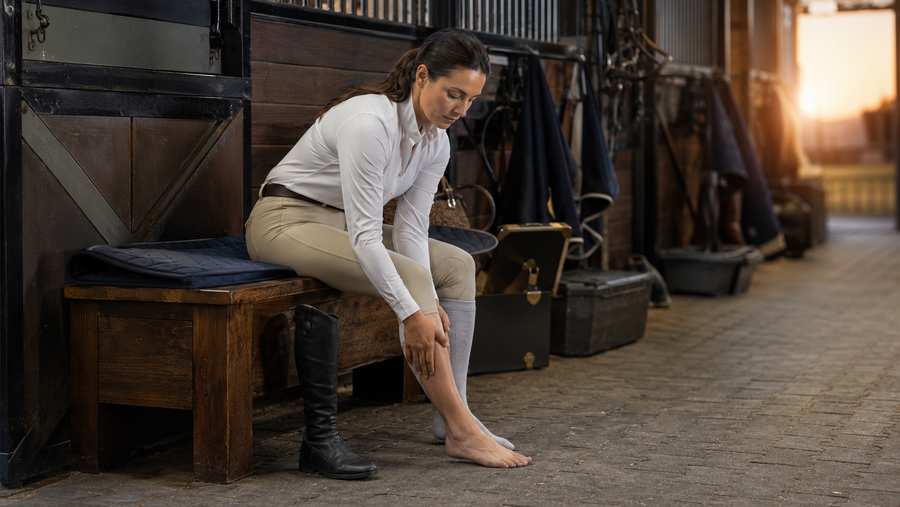
- Remove boots and socks. Look at both feet and ankles, not only the side that feels tired.
- Clean and dry the skin. Pay attention to toes, heels, pressure points, and any area that stayed damp.
- Walk easily. Use a few normal steps before deciding whether motion improves ordinary stiffness or reveals a functional problem.
- Move gently. Point and flex within a comfortable range, make small ankle circles, and stop if movement is sharp, unstable, or worsening.
- Correct the cause lane. Change socks, footwear, insole, floor setup, task order, or stirrup plan before the next long day.
- Use a topical only after the check. Clean, dry, intact skin comes first.
The 10-minute rider and rancher mobility routine adds hips, knees, shoulders, and posture when the whole chain feels the day.
How should boots, socks, braces, and compression affect the routine?
| Situation | What to do |
|---|---|
| Before boots | Use ReJüv™ only as the label permits, on clean, dry, intact skin. Let it dry fully before socks and boots. |
| Damp or dirty skin | Wash and dry first. Do not trap sweat, manure, dust, or mud beneath a topical and tight footwear. |
| Blistered or broken skin | Do not apply ReJüv™ over the area. Use appropriate wound or skin care and seek help when needed. |
| Brace or compression | Follow the product label and the support's instructions. Let the topical dry, avoid improvised occlusion, and stop if skin changes or symptoms worsen. |
| External heat | Do not combine ReJüv™ with heating pads or other external heat. |
Where does ReJüv™ fit in a feet-and-ankles routine?
ReJüv™ is a human-labeled topical wellness gel. It is menthol-free, capsaicin-free, low odor, colorless, and designed for people. Draw It Out® products remain for horses, and K9 Advanced™ products remain for dogs.
After the cause check, use ReJüv™ on intact external skin according to the current label. Avoid between the toes, broken skin, infected areas, severe irritation, eyes, mouth, and any area where a professional has told you not to apply a topical. Let it dry before socks, boots, or supports.
Shop ReJüv™ 8oz EZ Squeeze Gel
Use the before-and-after activity guide for the application sequence, the dry-time and reapplication guide for clothing and supports, and the ReJüv™ size comparison when choosing a package.
When do foot or ankle symptoms need medical care?
Seek prompt medical care for inability to bear weight, visible deformity, major or rapidly increasing swelling, severe pain, an open wound, signs of infection, or symptoms after a serious fall, twist, crush, or impact.
Numbness, weakness, a cold or discolored foot, new one-sided calf swelling, chest pain, shortness of breath, fainting, or sudden unexplained symptoms also require medical attention. Persistent or worsening symptoms deserve evaluation even when the day did not include one obvious injury.
ReJüv™ does not diagnose, treat, cure, prevent, heal, or reduce arthritis, inflammation, swelling, tendon injury, disease, or another medical condition.
Feet and ankles questions
Can I use ReJüv™ on my feet and ankles every day?
Follow the current ReJüv™ label. Apply only to clean, dry, intact external skin, avoid broken or irritated areas, and discontinue use if irritation occurs.
Can I apply topical gel before socks or work boots?
Apply only as directed and let the gel dry fully before socks, boots, braces, or compression. Do not use a topical to ignore poor fit, numbness, blisters, or pressure points.
Should I use a topical before or after a long day?
Either timing can fit if the label allows it. Before activity, start with clean dry skin and allow full dry-down. After activity, inspect, clean, dry, and correct the cause lane before applying.
Can ReJüv™ treat plantar fasciitis, arthritis, or an ankle sprain?
No. ReJüv™ is a topical wellness gel, not a drug or injury treatment. Diagnosed conditions and injuries need appropriate medical guidance.
Is standing still the same as walking all day?
No. Static standing and active walking load the body differently. A practical plan includes movement, position changes, task rotation, suitable footwear, and a safe floor setup.
General information only, not medical advice. For external use on intact skin. Follow the current product label and seek professional care for severe, unexplained, persistent, or worsening symptoms.