How Long Does a 16oz Horse Liniment Gel Bottle Last?
There is no universal application count. Use this seven-day bottle-life test to choose between 16oz single, two-pack, four-pack, and 64oz Gel.

Professional equine care
Good practitioners do not need a topical product to put on a show. They need one that fits the work, respects the horse, and does not argue with their hands.
The direct answer
Draw It Out® Liniment Gel and Concentrate fit professional equine bodywork because they give practitioners two useful application formats without relying on menthol, camphor, capsaicin, alcohol, witch hazel, added color, or added fragrance.
The ready-to-use Gel gives controlled, stay-put placement. The Concentrate gives broader spray-bottle or sponge coverage when prepared according to the current label. Both are odorless, colorless, sensation-free, and designed to support a careful hands-on routine rather than create theatrical heat, cold, sting, or smell.
Professional equine bodyworkers, massage therapists, chiropractors, rehabilitation practitioners, and modality providers make their living by paying attention. They compare movement. They read tissue response. They notice guarding, symmetry, temperature, skin condition, behavior, and what changes from one visit to the next.
A loud liniment can make the owner feel as if more is happening. A quiet liniment leaves the practitioner free to judge the horse.
The hands should read the horse. The liniment should not rewrite the reading.
Menthol cooling, alcohol sting, capsaicin heat, strong fragrance, and artificial color can give the person applying a product immediate sensory feedback. That feeling is real, but it is not proof that the product is a better fit for the horse or that a bodywork session accomplished more.
Draw It Out® does not depend on that sensory performance. For professionals, that means:
| Format | Best professional fit | Practical advantage |
|---|---|---|
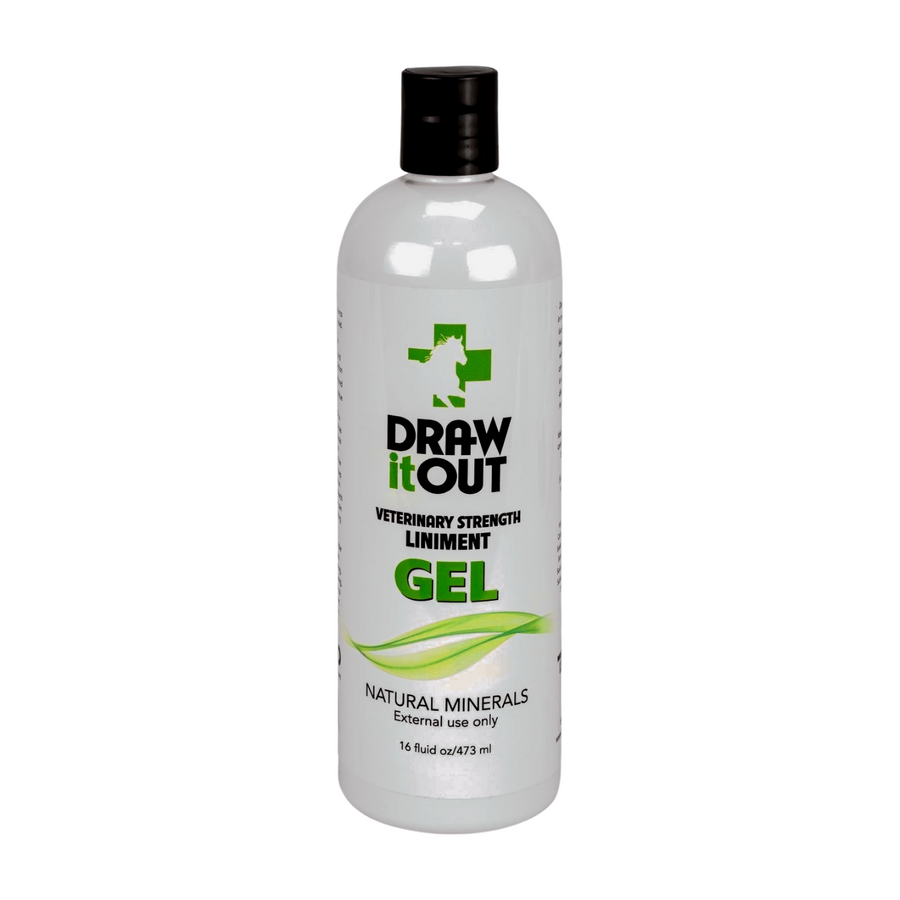
| 16oz Gel | Mobile kits, first-time professional users, targeted areas, client demonstrations | Ready to use and easy to place exactly where intended |
| 64oz Gel | Busy practices, trainers, multi-horse programs, frequent targeted use | Barn-size supply of the same stay-put Gel format |
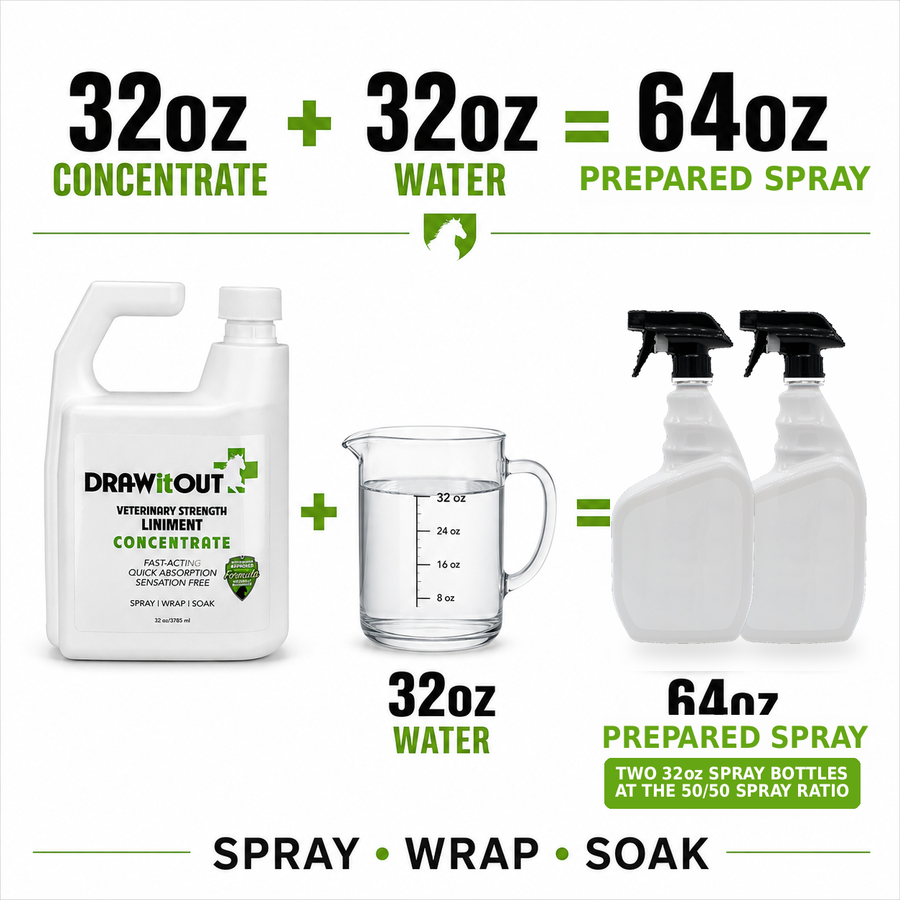
| 32oz Concentrate | Broader coverage, spray-bottle or sponge routines, practitioners learning the concentrate system | Application flexibility without starting with a gallon |
| 128oz Concentrate | Established practices, multi-horse barns, controlled refill systems | High-volume supply when measuring, labeling, sanitation, and storage procedures are already in place |
The rule is simple: choose Gel when targeted placement matters most. Choose Concentrate when broader coverage and mix-to-use flexibility matter more. Concentrate must be measured, prepared, labeled, stored, and used according to the current product label. Do not guess ratios or create mixtures with other topicals.
The Gel can fit localized hands-on work across backs, shoulders, hindquarters, hocks, legs, and other appropriate external areas. Its consistency makes deliberate placement easier and gives the practitioner control over how much area is covered.
Some practitioners may use Gel during an appropriate massage-style routine. Others prefer to complete their assessment and manual work on a clean, dry horse, then apply the Gel at the end. Both approaches keep the important distinction clear: the practitioner's technique is the professional service; the Gel is a topical support tool inside that service.
Do not aggressively massage a new, hot, painful, markedly swollen, or unexplained area. Stop and route the horse to its veterinarian when the presentation is outside routine care.
Concentrate makes sense when a practitioner wants broader external coverage or serves enough horses to justify a prepared spray-bottle, sponge, or wash-rack routine. It can help standardize a practice when every working container is clearly identified and every staff member follows the same current label.
The professional advantage is not permission to improvise. A concentrate system should use clean dedicated measuring equipment, clean application containers, clear labels, controlled storage, and one written process. The label controls preparation, not memory or barn folklore.
Draw It Out® is not an adjustment, does not move a joint, does not diagnose a spinal problem, and should never be represented as making an adjustment “hold.” Its lane is topical support before or after work when the practitioner determines that topical care fits the horse and the owner understands the directions.
The cleanest professional sequence is usually:
Important for kinesiology tape
Do not apply Gel or prepared Concentrate beneath adhesive kinesiology tape. Tape needs a clean, dry, product-free surface for proper adhesion. Complete the tape protocol first, or use topical liniment after the tape is removed and the skin has been checked.
Bodywork, chiropractic care, PEMF, kinesiology tape, cold therapy, wraps, and topical care can all have legitimate lanes. The professional standard is not to stack every available tool. It is to know why each tool is being used, what should be observed, and when the plan should stop.
For PEMF sessions, the practical default is a clean, dry horse for assessment and equipment contact, followed by topical Gel afterward. See the PEMF and Draw It Out® Gel pairing guide for the full sequence.
For red light therapy, the same clean starting point makes inspection and light delivery easier. Complete the device session according to its protocol, recheck the horse, then apply Gel and massage when appropriate. See the red light therapy and Draw It Out® pairing guide.
Manual therapies are established parts of many sport-horse programs, but the research varies by technique, condition, practitioner, and outcome. A veterinary review of equine manual therapies in sport-horse practice describes massage, mobilization, manipulation, and other hands-on techniques as tools for selected cases. It does not turn every technique into a universal answer.
The American Association of Equine Practitioners also emphasizes that allied providers belong in a coordinated equine healthcare team, with appropriate veterinary oversight and compliance with applicable law.
That standard protects good practitioners. It also protects the horse. Draw It Out® should be presented the same way: a practical topical choice, not a diagnosis, cure, treatment claim, or substitute for veterinary care.
What the practitioner can say:
“We completed today's hands-on session and rechecked your horse. Use Draw It Out® exactly as written on your aftercare note and the current product label. Watch the horse's movement, skin, heat, filling, and comfort. If the horse becomes lame, unusually painful, hot, markedly swollen, feverish, or worse instead of better, stop the routine and call your veterinarian.”
Specific instructions beat “use this when needed.” A professional recommendation should tell the owner which format to use, where it goes, how it is prepared, when to recheck, and which findings require a different level of care.
The professional standard
The best professional product is not the one that performs hardest for the owner. It is the one that fits the practitioner's work, gives the client a repeatable next step, and keeps the horse's welfare ahead of the sales pitch.
Yes, when the product fits the practitioner's method and is used on an appropriate external area according to the current label. Many practitioners may prefer to assess the clean, dry horse first and apply Gel during or after the hands-on portion.
The cleanest default is assessment first and Gel afterward. That lets the professional evaluate movement, skin, temperature, and response before adding another variable.
We make no claim that a topical liniment changes or extends a chiropractic adjustment. Draw It Out® fits the topical-support and aftercare lane.
Choose Gel for ready-to-use targeted placement. Choose Concentrate for broader spray or sponge coverage when the practice has a controlled measuring, labeling, storage, and sanitation process.
Yes. Gel and properly prepared Concentrate are designed for use under clean, properly fitted pads, boots, and wraps when used according to the current product label and normal equipment practices. Check the skin and equipment each time.
No. Adhesive tape should be applied to a clean, dry, product-free coat and skin. Use the topical liniment after tape removal when appropriate.
Stop routine care and involve the attending veterinarian for unexplained or worsening lameness, significant heat or swelling, marked pain, neurologic signs, fever, a concerning wound, unsafe behavior linked to discomfort, or findings beyond the practitioner's scope.
Build the professional kit
Start targeted with Gel, choose Concentrate for broader coverage, or review the professional programs available to qualified equine practitioners.
Shop 16oz Gel Shop 32oz Concentrate Explore Professional ProgramsEducational product information only. Use Draw It Out® products according to their current labels. Professional credentials, permitted activities, and supervision requirements vary by jurisdiction. This article does not replace veterinary diagnosis or treatment.
There is no universal application count. Use this seven-day bottle-life test to choose between 16oz single, two-pack, four-pack, and 64oz Gel.
See the 32oz horse liniment concentrate math, cost per prepared ounce, mixing discipline, and the exact barn routines where concentrate earns its space.
Meet Courtney Sabral of Chico, California, an experienced barrel racer and gymkhana rider whose care routine for Diamond and 26-year-old Ricky is built around consistency.
!