Horse Sensitive After a New Saddle Pad? What Owners Should Check
A practical horse health guide for sensitivity after a new saddle pad: sweat marks, dry spots, pad edges, saddle balance, and when to call for help.

Draw It Out® Horse Health Care
A sweaty saddle pad is not just laundry. It is a report card from the horse’s back, shoulders, girth area, and workload.
Direct answer
Look before brushing, compare left to right, feel the back, shoulders, withers, and girth area, then adjust tomorrow’s ride if the horse is reactive, rubbed, tight, or uneven. Use the Horse Health Library, Product Use Guides, or Solution Finder when the pattern points to a care routine.
Most riders pull the pad, hang it over a rail, and move on.
That is a missed opportunity.
Sweat tells stories. Dry spots tell stories. Ruffled hair tells stories. A horse that hollows, pins an ear, steps away from the brush, or starts the next ride tighter than normal is telling a story too.
The trick is reading the small clues before they turn into a horse that has to get loud.
Do not judge the ride only by how the horse performed. Judge it by what the horse’s back, hair, sweat pattern, and attitude say after the tack comes off.
Saddle pads collect evidence from pressure, motion, heat, dirt, hair, moisture, and rider balance. A normal sweat pattern is not always perfect, and every horse has its own baseline. But sudden changes deserve attention.
If yesterday’s pad looked even and today’s pad shows a hard dry spot, heavy pressure line, rubbed hair, or one side dramatically different from the other, do not blame the pad and walk away. Look at the horse.
None of this means every mark is a crisis. It means the horse gave you information. Good riders use it.
After the horse is untacked, checked, and cleaned, Draw It Out® 16oz Liniment Gel fits a practical daily-use routine for targeted back, shoulder, hip, neck, and leg care after work.

For larger areas, multiple horses, regular summer programs, or wash-rack workflows, Draw It Out® 32oz Liniment Concentrate gives riders a mix-to-use format that fits broader body and leg-care routines.
A dirty pad can turn yesterday’s sweat into tomorrow’s rub. Dried salt, packed hair, stiff edges, sand, dust, and old grime can sit against the same pressure points ride after ride.
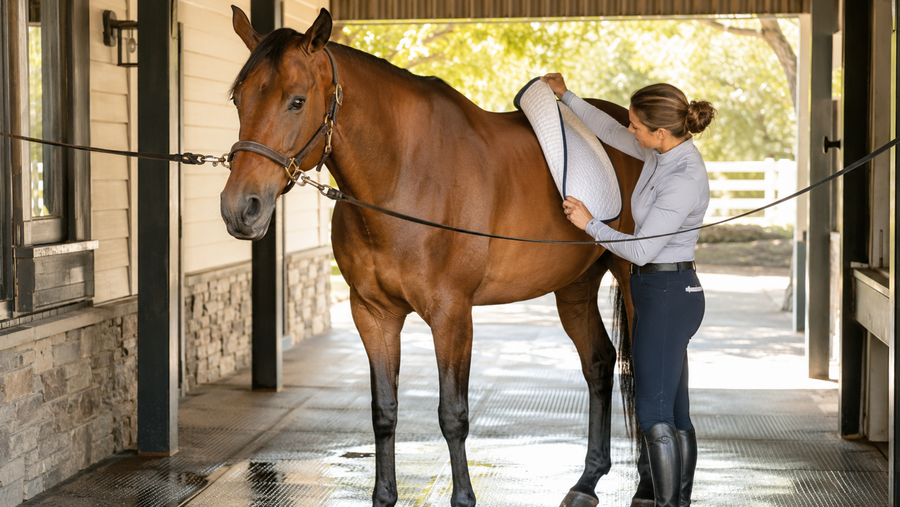
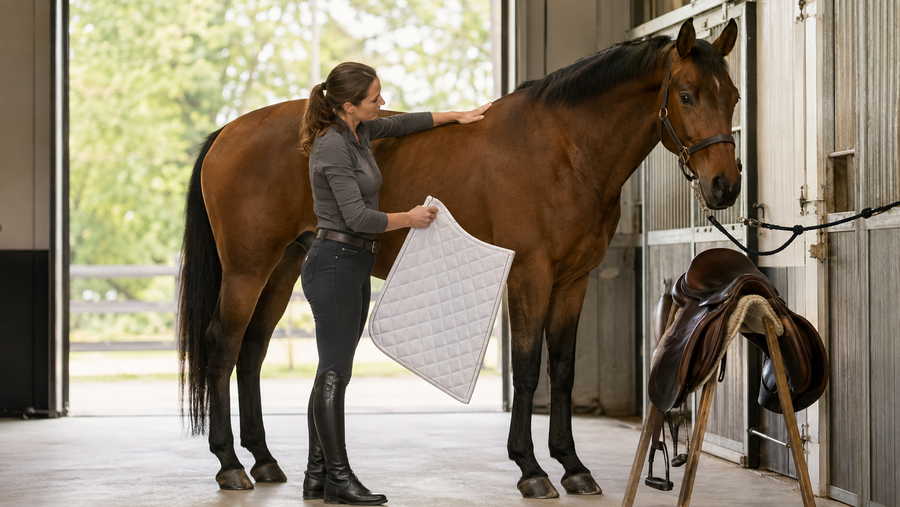
Brush the pad. Air it out. Wash when needed. Check seams, wear marks, liner condition, and areas that stay stiff. A clean horse under dirty tack is still wearing the problem.
Barn rule
Do not lose your mind over one odd mark after one odd ride. Maybe the pad shifted. Maybe the horse was wet before saddling. Maybe the footing changed. Maybe you rode crooked because you were tired.
But if the same dry spot, rub line, tight area, or attitude change keeps showing up, that is not random anymore. That is a pattern. Patterns deserve action.
The saddle pad is not just gear. It is a witness. Look before you brush. Feel before you assume. Clean the tack before it repeats the problem. Then support the horse standing in front of you, not the ride you hoped you had.
For more help choosing the right topical format, visit the Horse Health Library, use the Draw It Out® Solution Finder, or review the Product Use Guides.
A practical horse health guide for sensitivity after a new saddle pad: sweat marks, dry spots, pad edges, saddle balance, and when to call for help.
A practical horse health guide for fetlock puffiness after deep sand: heat, pain, symmetry, boot marks, footing depth, and vet red flags.
Heat rash under tack can involve sweat, friction, moisture, dirt, pressure, fit, or skin disease. Inspect the area and stop friction before reuse.
!