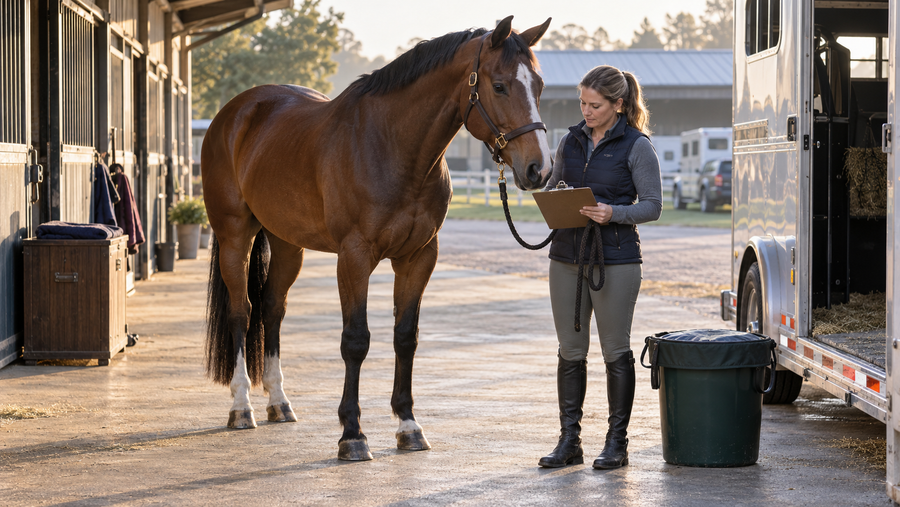
Horse Joint Supplements Away From Home: A Show-Barn Routine
Keep a horse joint-supplement routine consistent during travel with labeled storage, a serving log, clean handoffs, feed-acceptance checks, and missed-serving safeguards.

Real Rider Resource
Equine Infectious Anemia is a blood-borne viral disease with no treatment or vaccine. For riders, the practical priorities are current testing, clean equipment, verified travel rules, insect management, and prompt veterinary guidance.
Current alert | September 22, 2026
Perth East, Ontario: The Equine Disease Communication Center reported that the Canadian Food Inspection Agency confirmed Equine Infectious Anemia in a horse on September 17. An accredited veterinarian had tested the horse at the owner's request to meet a U.S. export requirement. No clinical signs were noted when the sample was collected.
Movement controls now apply to the infected horse and on-premises contact animals while CFIA investigates, completes follow-up testing, and traces possible movements. The notice does not identify a U.S. destination, confirm that the horse entered the United States, or establish exposure to any U.S. horse or premises.
Rider next step: Treat export, import, event, sale, and boarding tests as decision-making checkpoints, not paperwork afterthoughts. Match every test record to the horse, verify current requirements before loading, and contact your veterinarian and the responsible animal-health officials if a result, exposure history, or movement status changes.
Sources: EDCC alert 5259 and the USDA APHIS EIA overview. Reviewed September 22, 2026.
A Coggins test screens for EIA. A negative result documents the horse's status at the time of testing, but current movement, event, sale, and boarding requirements still need to be checked before hauling.
Equine Infectious Anemia affects horses, ponies, mules, donkeys, and other equids. It does not threaten human health. Clinical signs can range from fever, weakness, swelling, and anemia to sudden death, but some infected horses show mild, intermittent, or no obvious signs.
Horses that survive infection remain lifelong carriers. That is why a positive result is handled through veterinarians and animal-health officials rather than a wait-and-see barn routine.
EIA moves through infected blood. Biting horseflies and deerflies can transfer blood between equids, but USDA APHIS identifies human-facilitated blood transfer as the most common route in the United States today.
The Coggins test is an official blood test used to detect antibodies associated with EIA. Your veterinarian collects the sample and handles the documentation. A recently infected horse may not test positive immediately, so exposure questions and test timing belong with your veterinarian and state animal-health officials.
USDA APHIS recommends annual EIA testing, but legal and facility requirements can vary. Verify the rules for the destination, event, sale, boarding barn, and states involved before you load the trailer.
For the rest of your show-day paperwork and packing routine, use the Show Day Prep Guide.
Stop nonessential movement, separate the horse as directed, and contact your veterinarian and state animal-health officials. Do not move a suspected or confirmed horse to another barn, event, sale, or pasture unless officials specifically authorize it.
There is no vaccine or curative treatment for EIA. Positive equids are managed under regulatory direction, which can include permanent isolation under quarantine or euthanasia.
Keep testing current, verify movement rules before hauling, use sterile equipment, reduce biting-fly pressure, and involve your veterinarian early. EIA prevention is a layered biosecurity job, not a product promise.
A Coggins test screens an equid's blood for antibodies associated with Equine Infectious Anemia. Your veterinarian handles testing and documentation.
Yes. Some infected horses show mild, intermittent, or no obvious signs, but survivors remain lifelong carriers and can transmit the virus.
No. Reducing biting-fly pressure is one supporting biosecurity step, but it cannot replace clean equipment, testing, movement controls, quarantine, or veterinary guidance.
Stop nonessential movement, separate the horse as directed, and contact your veterinarian and state animal-health officials. Follow official testing and quarantine instructions.
For more practical biosecurity and emergency education, visit the Horse Health Library.
Educational only. This article does not replace veterinary or regulatory guidance. Testing, exposure decisions, movement rules, and positive-test procedures should be handled through your veterinarian and state animal-health officials.
Keep a horse joint-supplement routine consistent during travel with labeled storage, a serving log, clean handoffs, feed-acceptance checks, and missed-serving safeguards.
Anthrax is rare but can progress rapidly in horses. Learn who is at risk, what signs require urgent veterinary action, why suspected carcasses should be left alone, and...
A rider-first show and travel hydration guide for horses that drink less away from home, including intake tracking, familiar-water planning, first steps, electrolyte limits, and veterinary red flags.
!