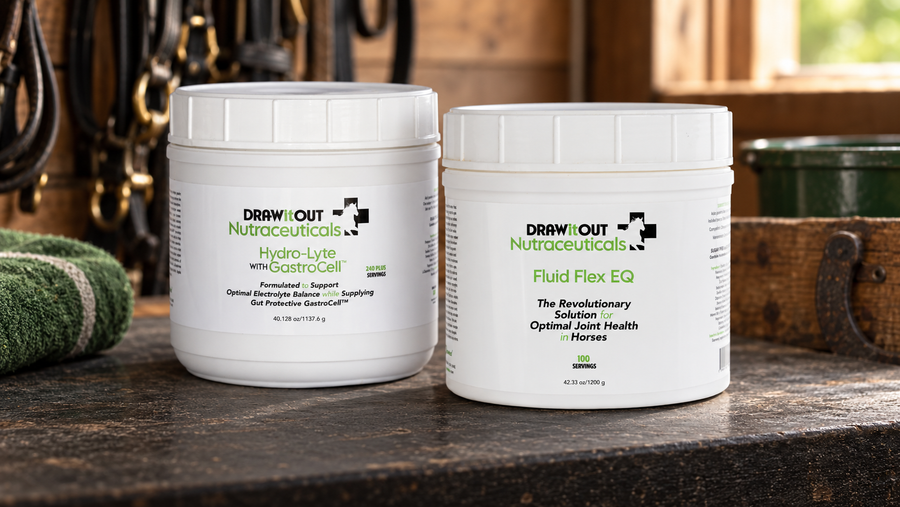
What’s in Hydro-Lyte® and Fluid Flex EQ®? The Name on the Front Matters
See every declared ingredient in Hydro-Lyte® and Fluid Flex EQ®, why it is included, how each formula differs, and what the Draw It Out® name on the front...

Quick answer: Keep a horse's joint-supplement routine boring when traveling. Pack the original labeled container, use the correct dedicated measure, log each serving, protect the product from heat and moisture, and avoid changing several feeds or supplements at the show. If a serving is missed, follow the current label or ask the veterinarian or nutrition professional. Do not double the next serving unless specifically directed.
Home routines fail away from home for ordinary reasons. The scoop is in another trailer. The person feeding assumes somebody else did it. A bag gets damp. A horse refuses an unfamiliar meal. By the time everyone compares notes, nobody is certain what the horse received.
A good travel system removes guesswork before the truck leaves.
Keep the product identity, directions, lot information, and warnings with the supplement. An unmarked plastic bag is not a useful system.
Use the measure specified for that product. Do not borrow a coffee scoop, feed cup, or another supplement's scoop.
List the horse, product, label-directed amount, normal feed, contact person, and any veterinary instructions.
Record date, time, initials, feed acceptance, and anything unusual. A checkmark prevents duplicate servings better than memory.
Keep the container sealed, upright, and protected from moisture, contamination, and temperature extremes according to the label.
Decide who feeds if the primary person is riding, delayed, sick, or at another arena. The handoff should be written, not assumed.
| Date and time | Person | Label serving given | Feed accepted? | Notes |
|---|---|---|---|---|
| Arrival evening | Initials | Yes / No | All / Some / Refused | Water, manure, attitude, travel observations |
| Competition morning | Initials | Yes / No | All / Some / Refused | Movement baseline, appetite, workload plan |
| Competition evening | Initials | Yes / No | All / Some / Refused | Recovery, legs, feet, next-day plan |
The log is not busywork. It separates “I think he got it” from a record the whole team can trust.
Do not keep adding new flavors and products until the meal becomes unrecognizable. First check the feed itself, water access, travel stress, heat, dental issues, illness, medication, and whether the horse is eating anything else.
Record it. Then use the current label or ask the veterinarian or equine nutrition professional what comes next. Do not automatically double the next serving. A missed box on the log is useful information. A guessed correction creates a second uncertainty.
Fluid Flex EQ® is a granulated, feed-through horse joint and mobility supplement that supplies 100 mg of sodium hyaluronate per label serving.
New or worsening lameness, heat, swelling, hoof pain, non-weight-bearing behavior, stumbling, neurologic-looking changes, severe soreness, fever, or sudden reluctance to move needs professional evaluation. A travel routine can preserve consistency. It cannot diagnose the horse.
Use the original labeled container whenever possible. Pre-portion only when the product label, storage needs, event rules, and barn controls make it appropriate, and keep every portion clearly identified and protected from moisture and contamination.
Generally, avoid introducing a new supplement during a high-change travel period unless the veterinarian or nutrition professional has directed the plan.
Use one visible serving log and require initials immediately after feeding. The system should make a duplicate serving difficult.
Use the amount and schedule on the current Fluid Flex EQ® label. Do not add a loading phase unless that label or a qualified professional specifically directs one.
Fluid Flex EQ® gives the barn a clear serving-based format. The real advantage comes from pairing the product with a routine that survives trailers, early mornings, staff handoffs, and busy show days.
View Fluid Flex EQ®Then use the Fluid Flex EQ® Feeding Routine and the cost-per-day guide to finish the plan.
Feed according to the current label. This article is general education and does not replace veterinary diagnosis, treatment, nutrition planning, or current competition rules.
See every declared ingredient in Hydro-Lyte® and Fluid Flex EQ®, why it is included, how each formula differs, and what the Draw It Out® name on the front...
A year-round horse joint supplement can fit an individual plan, but consistency, label discipline, seasonal management, and regular review matter.
There is no universal age to start a horse joint supplement. Use workload, history, mobility, veterinary guidance, label math, and a clean evaluation plan.
!