Low-Odor Topical Gel for Work: What to Look For Before You Buy
Compare low-odor topical gels by label category, scent, sensation, dry-down, packaging, clothing fit, and workplace practicality before you buy.

ReJüv™ Recovery Journal
Knees absorb more than riding time. Barn aisles, concrete floors, stairs, squatting, pushing wheelbarrows, long drives, lifting, and standing all count toward the day.
Workload is the sum of position, force, repetition, duration, and the surface underfoot. OSHA identifies force, repetitive tasks, awkward or static postures, kneeling, squatting, and combined exposures as ergonomic risk factors. Its lower-extremity guidance also notes the demands of prolonged standing, pushing heavy loads, uneven travel paths, and repeated kneeling. Read the official ergonomic risk-factor guidance and lower-extremity solutions.
That maps closely to real barns and ranches. A feed run can combine a hard floor, a loaded cart, a tight turn, and repeated stops. Grooming or equipment repair can hold the knees in one position. Riding adds mounting, dismounting, posting, two-point work, and time with the knees flexed. Driving then replaces movement with a long static position.
The useful question is not, “Which one task caused this?” It is, “Which parts of today’s load can I change before I add another round?”
| Signal | Next step | Topical role |
|---|---|---|
| Green: ordinary end-of-day fatigue, normal walking, no new swelling or instability | Use easy movement, change position, and adjust the next task | A label-directed wellness routine may fit |
| Yellow: recurring change, altered gait, reduced range, or symptoms returning with the same task | Reduce the load, review footwear and work setup, and consider professional guidance | Do not let application replace the workload change |
| Red: fall or impact, inability to bear weight, visible deformity, locking, major swelling, heat and redness, numbness, weakness, or rapid worsening | Stop and seek appropriate medical care | Skip self-care as the answer |
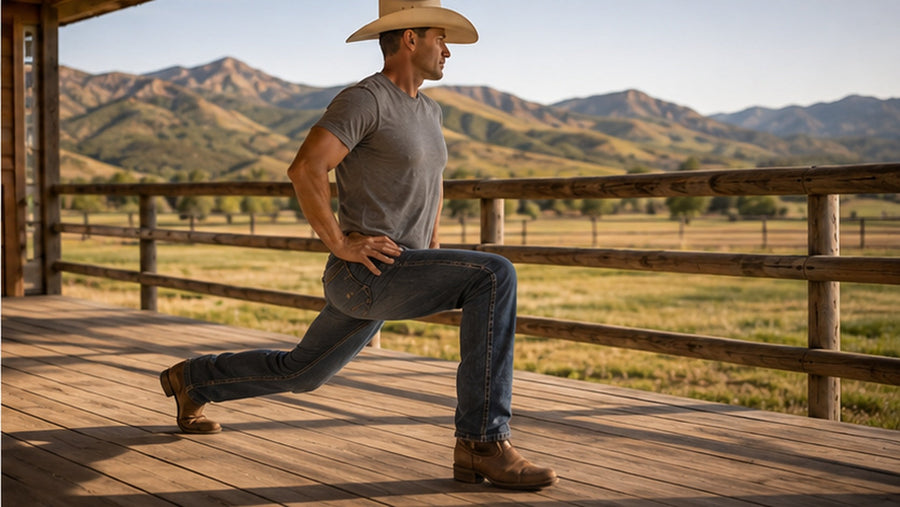
Use a position-change rule instead of waiting for the knees to demand attention. After a long drive, walk before lifting. After standing at the wash rack, use the next task as a movement break. When work requires kneeling, use appropriate padding and avoid making the knee a tool against a hard surface.
For a broader movement plan, use the daily mobility routine for riders and ranchers. For timing around sweat, showers, braces, and clothing, use how to use ReJüv™ before and after activity.
ReJüv™ is the human-labeled topical wellness gel in the Draw It Out® family. Draw It Out® Liniment is the horse product lane, and K9 Advanced™ is the dog product lane. Do not substitute an animal-labeled product for the human-labeled option.
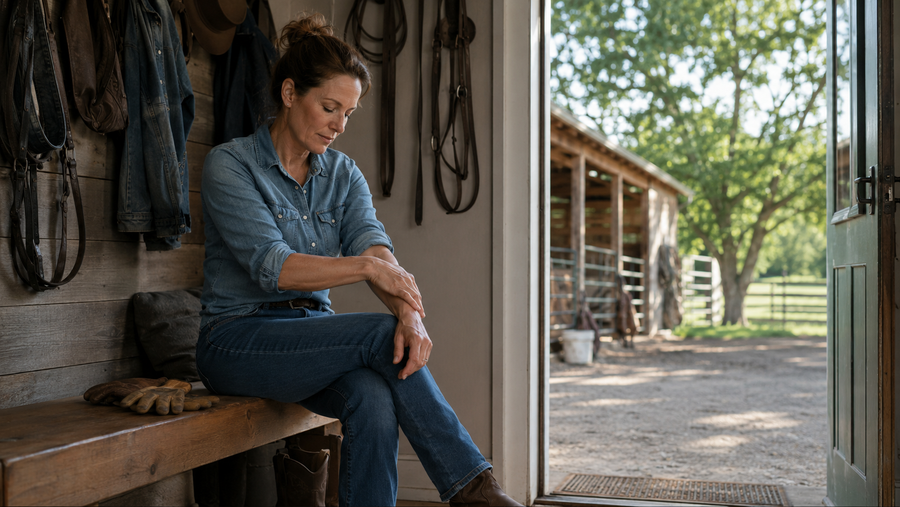
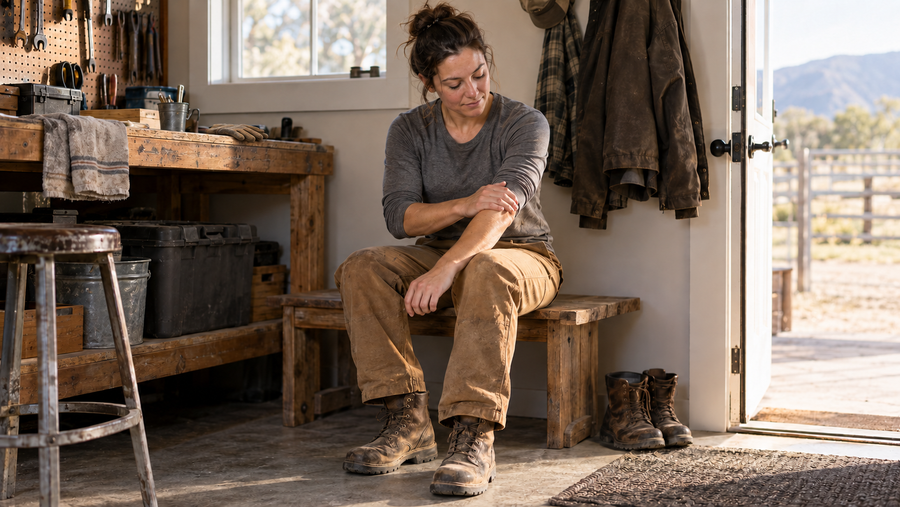
Follow the current ReJüv™ label. Use it only on clean, dry, intact external skin. Avoid eyes, mouth, broken or irritated skin, external heat, and improvised topical combinations. Patch-test sensitive skin and discontinue use if irritation occurs. Let the gel dry before jeans, breeches, braces, or compression sleeves so the routine is predictable and transfer is limited.
The product is a handoff after the useful work has already been done: workload check, movement, skin preparation, and an honest red-flag screen.
Compare formats in the menthol-free versus menthol guide, then use the ReJüv™ size comparison to choose a work-bag or home format.
Seek prompt medical care after a significant fall or impact, for a visibly deformed knee, inability to bear weight, rapid or severe swelling, a hot red joint, fever, new numbness or weakness, repeated giving way or locking, or one-sided calf swelling with chest pain or shortness of breath. Persistent, unexplained, or worsening symptoms also deserve evaluation.
A wellness routine cannot determine whether a symptom comes from a ligament, meniscus, bone, infection, clot, inflammatory condition, or another cause. If safe movement or work is changing, the decision has moved beyond a product choice.
Use it only as directed by the current product label. Patch-test sensitive skin and stop if irritation occurs.
Either timing can fit when the label allows it. Before activity, let it dry and still use a movement-based warm-up. After activity, cool down, clean and dry the skin, and check function first.
Let the gel dry first and follow the label. Do not add external heat or an improvised tight covering, and stop if friction or irritation develops.
No. ReJüv™ is a human topical wellness gel. It is not intended to diagnose, treat, cure, or prevent arthritis or another disease.
Use a product labeled for people. ReJüv™ is the human product lane. Draw It Out® Liniment is labeled for horses.
Safety note: This article is general information, not medical advice. ReJüv™ is for external use on people. Follow the current label, use only on clean, dry, intact skin, avoid eyes, mouth, broken skin, external heat, and improvised combinations, patch-test sensitive skin, stop if irritation occurs, and seek professional care for severe, sudden, traumatic, unexplained, persistent, or worsening symptoms.
Compare low-odor topical gels by label category, scent, sensation, dry-down, packaging, clothing fit, and workplace practicality before you buy.
What menthol-free topical gel means, who may prefer the low-sensory format, what to compare before buying, and where ReJüv™ Gel fits.
Hips tight after a long drive or sitting? Use this six-minute transition routine before barn work: walk, open the hips gently, wake up the glutes, hinge, and reassess.
!