Before and after the ride
Horse Warm-Up and Cool-Down: A Practical Rider’s Guide
Quick answer: A horse warm-up should begin with a pre-ride check and progress from relaxed walking to the movements required for that day. A cool-down should reduce effort gradually while the rider checks breathing, sweating, movement, legs, tack areas, hydration, and behavior. Neither phase has one correct number of minutes. The horse, workload, weather, footing, and response determine the plan. Specific stretches belong in an individually demonstrated exercise program; follow its timing before or after work.
Warm-up and cool-down are not filler around the ride. They are the two moments when a rider can learn the most: how the horse arrived, how the horse changed through work, and what tomorrow's plan should be.
Warm-up and cool-down do different jobs
| Phase | Primary goal | What the rider should notice |
|---|---|---|
| Before mounting | Establish today's baseline | Attitude, gait, legs, hooves, back, tack fit, skin, weather, and footing |
| Warm-up | Build movement and attention gradually | Rhythm, symmetry, willingness, steering, transitions, and whether movement improves |
| Cool-down | Reduce effort without an abrupt stop | Breathing, sweating, temperature, gait, behavior, and recovery toward normal |
| After untacking | Check the full response to the ride | Legs, hooves, back, girth and saddle areas, hydration, appetite, manure, and later or next-day changes |
Start the warm-up before you mount
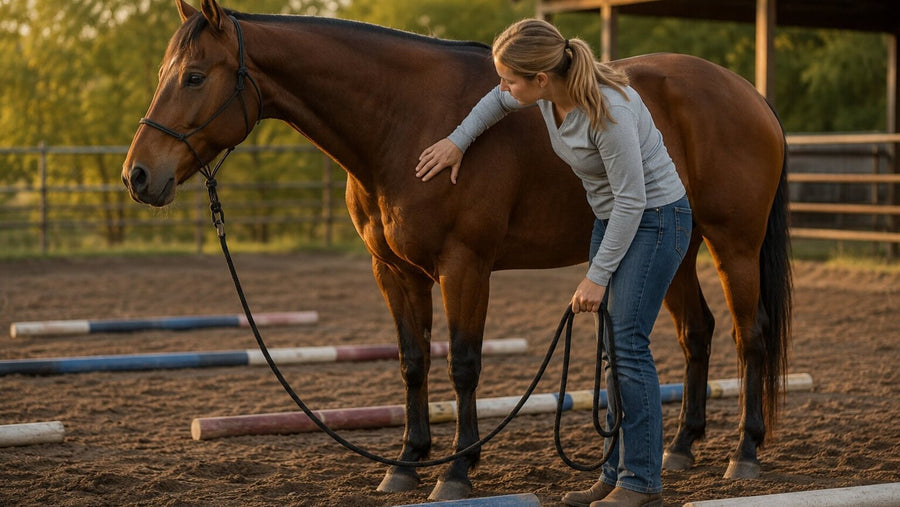
Watch the horse walk out of the stall, paddock, or trailer. Groom with your hands as well as your eyes. Compare all four legs, pick out the hooves, check the back and girth path, and look at the skin where tack and boots will sit.
Horse check
Notice gait, posture, attitude, heat, swelling, sensitivity, wounds, hoof findings, and anything that differs from the horse's normal.
Tack and equipment
Check saddle placement, pad condition, girth, bridle, boots, wraps, and clean contact surfaces. Equipment that worked last month may fit differently today.
Environment
Consider surface depth, slick areas, hard ground, temperature, humidity, wind, distractions, and whether the arena is crowded.
Workload
Match the warm-up to the planned task, the horse's fitness, recent time off, travel, age, and response to the previous session.
Should I stretch my horse before or after riding?
Begin a normal riding session with a progressive movement warm-up. Use specific stretches before or after work only according to a plan suited to your horse and demonstrated by your veterinarian or a qualified equine rehabilitation professional working with them. Ask where each exercise belongs relative to walking, ridden work and cool-down. An online routine cannot set that schedule for every horse.
Warm-up, stretching and strengthening have different purposes
- Warm-up: easy movement that builds gradually toward the day's work. Watch rhythm, comfort and the horse's response as you increase demand.
- Stretching or mobilization: a specific movement through a chosen range. In a dynamic exercise, such as a prescribed baited or “carrot” stretch, the horse moves voluntarily. In a passive stretch, a handler moves a limb or another body part. The technique and range matter.
- Strengthening: a planned exercise program repeated and progressed over time. A single stretch before a ride cannot establish the horse's fitness for that day's workload.
These categories can overlap in a rehabilitation program. Keep the purpose clear rather than adding exercises simply because they appear on a daily stretching checklist. UC Davis emphasizes matching rehabilitation exercise to the injury and working with a veterinarian and equine rehabilitation specialist.
Get the exercise demonstrated on your horse
Before adding a new exercise, ask the professional to watch you perform it and confirm:
- The job: why this exercise is appropriate for this horse, and any restrictions from an injury, surgery or recent examination.
- The setup: suitable footing, handler position, balance and a comfortable range of movement.
- The schedule: when to perform it, repetitions, any hold time, frequency and when the plan should be reviewed.
- The stop signs: what response is expected and which changes mean stop and contact the veterinarian.
Keep the instructions where everyone caring for the horse can find them. A 2025 veterinary physiotherapy audit examined exercise prescription and whether owners could perform the correct technique. That supports getting your own technique checked, even when an exercise looks simple.
Let a new problem change the plan
Stop if the horse resists, loses balance, pulls away or appears uncomfortable. Do not force a limb farther, chase a larger neck bend or repeat an exercise to “work out” a new problem. New lameness, weakness, back sensitivity, heat or swelling needs veterinary assessment before adding stretches or more work.
For a horse coming back from a break, use the conditioning after time off guide. After injury or stall rest, follow the veterinarian's restrictions and use the return-to-movement checklist after stall rest to organize observations and questions.
Further reading: UC Davis: exercise therapy in equine rehabilitation; Veterinary Evidence: dynamic mobilization exercise prescription and owner technique; 2024 review of equine warm-up strategies and evidence limits.
A progressive horse warm-up
Begin with relaxed walking
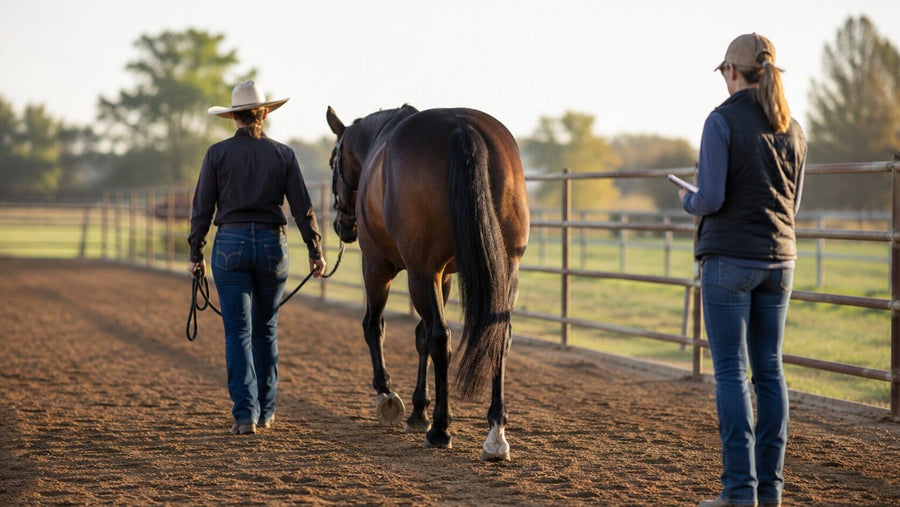
Allow the horse to establish a comfortable rhythm on safe footing. Use straight lines and large figures before tight turns or demanding lateral work. Hand-walking may be useful when the horse has hauled, the weather is cold, or you want to observe movement before mounting.
Add direction and bend gradually
Use large circles, changes of direction, and simple steering questions. The horse should stay willing and become more coordinated, not more resistant.
Introduce transitions
Add walk-halt, walk-trot, and other transitions appropriate for the horse. Keep the early repetitions clear and unhurried. Watch whether the horse stays even in both directions.
Prepare for the specific job
Only after the basic rhythm feels normal should you add the movements, speed, collection, terrain, jumps, cattle work, or other demands of the session.
The useful test: an effective warm-up should make the horse more organized and comfortable for the planned work. If movement becomes worse, resistance increases, or the horse shows pain, lameness, weakness, or distress, stop and reassess.
How long should a horse warm up?
There is no universal time. A fit horse on a mild day may need a different progression than a senior horse on a cold morning, a horse returning from time off, or a horse that just stepped off a trailer.
- Use more gradual walking when weather is cold or the horse starts slower than usual.
- Use more observation after travel, a shoeing change, time off, or a hard previous session.
- Reduce intensity when the footing, heat, humidity, or horse's response makes the original plan inappropriate.
- Do not continue warming up indefinitely in the hope that a concerning gait change will disappear.
Signs you may be overdoing the warm-up
More is not automatically better. A warm-up can become a workout before the planned work even begins.
- The horse feels flatter, less responsive, or more fatigued as the warm-up continues.
- Breathing and sweating are already disproportionate to the early workload.
- Transitions lose quality instead of improving.
- The horse becomes more uneven, resistant, or uncomfortable.
- The warm-up routinely consumes the horse's available energy for the actual job.
A progressive horse cool-down
Reduce the demand gradually
Move from the hardest work to easier work before returning to a relaxed walk. Avoid an abrupt stop after intense effort unless safety or a medical concern requires it.
Watch breathing and behavior
Notice whether breathing, alertness, and movement trend toward the horse's normal. Weather, fitness, workload, and individual history affect the pace.
Manage sweat and temperature
Untack when safe, use water, scraping, towels, shade, fans, or blankets according to conditions, and keep checking the horse. Do not apply one fixed cooling formula to every climate and horse.
Recheck after untacking
Check the back, withers, girth path, legs, hooves, skin, sweat patterns, and equipment marks. Offer water and observe appetite, manure, urine, and behavior when relevant.
When is the cool-down finished?
A quiet walk for a fixed number of minutes is not proof that the horse has recovered from the work. Finish based on the whole horse and the conditions. Breathing should be trending appropriately, movement should remain normal, and the horse should not show distress, weakness, unusual dullness, persistent abnormal sweating, or another concerning sign.
Continue monitoring after the immediate cool-down. The later check and next morning often reveal whether the workload was appropriate.
Where liniment may fit
Liniment can fit a label-directed pre-ride or post-ride body-care routine after the horse has been checked. Use it only on clean, dry, intact skin and follow the current label for placement, amount, frequency, and use with pads, boots, or wraps.
Before a ride
A thin, controlled application may fit an established grooming and warm-up routine. It does not replace movement, tack checks, appropriate footing, or evaluation of an abnormal finding. Read the separate horse liniment before exercise guide for product-timing detail.
After a ride
After untacking and checking the horse, Draw It Out® 16oz Horse Liniment Gel may fit a controlled hands-on routine. Draw It Out® 32oz Horse Liniment Concentrate offers broader format flexibility when used as the current label directs.
Draw It Out® liniment is odorless and colorless and is positioned without menthol, capsaicin, alcohol, or witch hazel. Follow the current governing-body rules and the product label when competition eligibility matters. No topical product should be used to push a horse through lameness, pain, marked heat or swelling, a wound, or abnormal behavior.
For format choice and application boundaries, use the horse liniment use guide. Choose Draw It Out® 16oz Horse Liniment Gel when targeted, ready-to-use routine care fits the job.
Stop and call for help when needed
Contact your veterinarian promptly when the horse has:
- New or worsening lameness, weakness, stumbling, or reluctance to move
- Marked heat, swelling, pain, a puncture, or another significant wound
- Abnormal breathing, fever, collapse, confusion, or distress
- Persistent abnormal sweating, failure to cool as expected, or signs of heat illness
- Colic signs, reduced appetite, unusual dullness, or behavior that is clearly abnormal
- A problem that worsens during movement instead of improving
Warm-up and cool-down FAQ
Does turnout replace a warm-up?
No. Turnout can provide useful movement, but you should still check the horse and progress from easy work to the specific demands of the ride.
Should every warm-up include lunging?
No. Lunging can add circles and workload before you mount. Use it only when it serves a clear purpose, the footing is safe, and the horse can work comfortably on the chosen circle.
Can I ride immediately after hauling?
Check the horse first. Trip length, hydration, temperature, behavior, legs, hooves, breathing, and movement all matter. Use the post-haul horse checklist before deciding.
Is walking enough for a cool-down?
Walking is often one part of the cool-down. Also consider breathing, sweating, temperature, weather, hydration, gait, behavior, and the demands of the work.
Should I stretch my horse before or after riding?
Begin normal work with a progressive movement warm-up. If your horse has a stretching or rehabilitation program, follow the timing demonstrated by your veterinarian or the equine rehabilitation professional working with them. Ask how each exercise fits around walking, ridden work and cool-down. Do not force an uncomfortable horse through a stretch.
Are carrot stretches a replacement for warming up?
No. A prescribed carrot stretch is a dynamic mobilization exercise in which the horse moves voluntarily toward a baited position. It serves a specific purpose in an exercise plan. Continue to check the horse and build gradually from easy movement toward the demands of the ride.
Can liniment replace stretching or conditioning?
No. Liniment belongs to a label-directed topical body-care routine. It does not replace a movement warm-up, a prescribed exercise program or veterinary assessment. Draw It Out® 16oz Horse Liniment Gel is a ready-to-use option for targeted routine care; follow the current label.
Bottom line
Warm up with a purpose, cool down with your eyes open, and let the horse's response change the plan. The goal is not to complete a ritual. The goal is to make a responsible decision before, during, and after the ride.