ReJüv™ Recovery Journal
Topical Gel for Hands and Forearms: A Grip-Work Routine
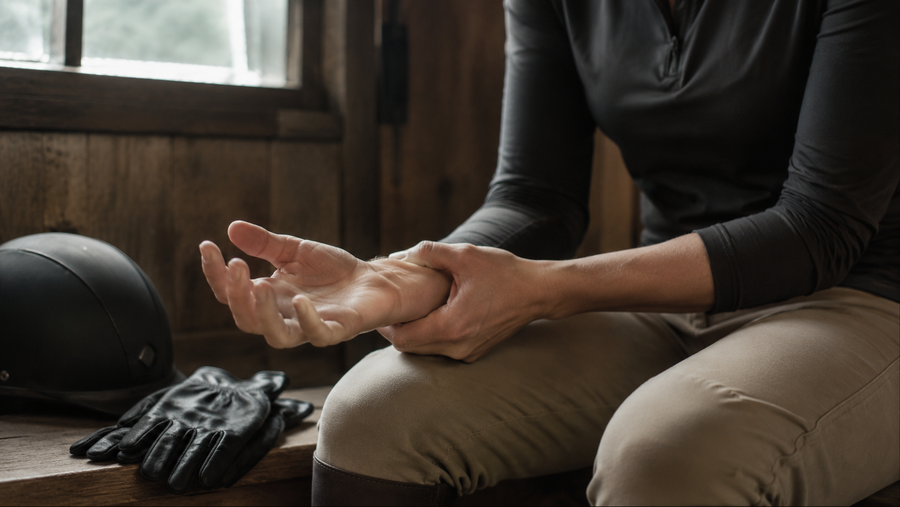
Reins, lead ropes, clippers, buckets, gates, tools, steering wheels, and keyboards all load the same chain. Barn work often repeats that load through the hands, wrists, and forearms, so a useful routine treats grip as one connected task rather than separate hand and elbow problems.
Why does grip work travel from the hand through the wrist into the forearm?
Finger muscles, wrist position, forearm tension, elbow angle, shoulder position, and trunk stability work together. When a rider pulls a stuck gate, holds steady contact, carries a water bucket, clips for an hour, or drives a long route, the hand is only the visible end of the chain.
Barn work can stack that load through water buckets, hose nozzles, feed bags, pitchforks, wheelbarrows, clippers, and stubborn knots before any one task looks dramatic.
Static grip
Holding reins, a steering wheel, or a tool without much position change can create fatigue even when the load is not heavy.
Repeated grip
Brushing, braiding, clipping, typing, tying, and opening latches repeat small movements until the forearm has done far more work than it seemed.
Awkward leverage
A full bucket, long-handled tool, or gate that moves suddenly can multiply force through the wrist and elbow.
Skin exposure
Dust, frequent washing, cold weather, blisters, torn cuticles, and grooming residue can make hand skin unsuitable for a topical even when the muscles feel tired.
What should you check before calling it ordinary post-work fatigue?
Use a 30-second function check before adding stretches or a topical:
- Look: check for cuts, punctures, bites, blisters, swelling, bruising, color change, or a crooked finger or wrist.
- Move: slowly open and close the hand, turn the palm up and down, bend and straighten the elbow, and compare sides.
- Feel: notice numbness, tingling, unusual heat, sharp pain, or loss of normal sensation.
- Grip lightly: hold an empty cup or soft towel. Do not use a maximum squeeze as a test.
- Review the event: a fall, rope jerk, kick, crush, puncture, or sudden pop is not routine fatigue.
What is a practical two-minute reset after grip-heavy work?
- Put the load down safely. Secure the horse, tool, gate, or vehicle before thinking about your arm.
- Shake out without snapping. Let the fingers loosen for ten seconds.
- Make five easy hand opens. Spread the fingers comfortably, then close them without a hard squeeze.
- Turn the palms. With elbows near the body, rotate palms up and down five times.
- Bend and straighten the elbows. Use a pain-free range and keep shoulders relaxed.
- Reset the shoulders. Take two slow breaths while letting the shoulders drop away from the ears.
- Change the next task. Switch hands when safe, reduce load size, adjust tool height, or take a short break before repeating the same grip.
The goal is not to force a stretch. It is to stop accumulating the same load without interruption. The NIOSH ergonomics overview emphasizes reducing awkward posture, force, and repetition by fitting the task to the worker.
How should the routine change by task?
| Task | Likely load pattern | Better next move |
|---|---|---|
| Reins and lead ropes | Static grip, wrist angle, sudden pull | Secure the horse, loosen the fingers, review rein length and hand position, and do not normalize a rope-burn or jerk injury. |
| Clipping, braiding, grooming | Repeated finger and wrist motion | Change position, raise or lower the work, alternate tasks, and schedule short hand breaks before fatigue changes technique. |
| Buckets, hay, gates | Heavy grip plus carrying or pulling | Use two smaller loads, a cart, better leverage, or another person. Turn with the feet instead of twisting under load. |
| Driving and hauling | Long static position | Use safe rest stops, relax the grip, change hand position, and move the shoulders and elbows before unloading. |
| Desk, phone, paperwork | Small repeated motion and fixed posture | Move the device or keyboard, rest the forearms, and break up long blocks with a different task. |
For a whole-body version after chores, use the barn-chores and hay-hauling routine. Farriers can use the dedicated farrier recovery guide.
Fix the equipment that creates the same fight every day. Replace stiff latches, worn snaps, damaged hose ends, awkward knots, and poorly maintained clippers instead of asking the hands and wrists to overpower them on every shift.
Where can a human topical gel fit?
A topical belongs after the function and skin checks, not before them. Wash away dust, sweat, grooming products, and dirt. Dry the area fully. Apply only to intact skin, use a thin layer, and let it absorb before returning to reins, tack, tools, food preparation, contact lenses, children, or animals.
ReJüv™ is a human-labeled, menthol-free, capsaicin-free topical wellness gel. Draw It Out® liniment is labeled for horses. K9 Advanced™ is the dog-care lane. Do not substitute across species.
Hands transfer products easily. If the palm is part of the application area, be especially deliberate about drying and hand washing. Do not use ReJüv™ on cracked, bleeding, blistered, burned, infected, or severely irritated skin. Do not layer it with medicated creams, patches, or external heat.
For a portable format, compare all available sizes in the ReJüv™ size guide. For a controlled, one-handed handoff after the practical routine, the 8oz EZ Squeeze is the clearest fit.
When should hand or forearm symptoms get medical care?
Seek prompt care after a crush, puncture, bite, fall, rope jerk, kick, suspected fracture, deep cut, or loss of normal function. Get evaluated for severe or increasing swelling, deformity, spreading redness, drainage, fever, color change, persistent numbness, weakness, or a hand that cannot open, close, or grip normally.
Sudden arm or hand weakness with facial droop, speech trouble, chest pain, faintness, or shortness of breath is an emergency. A topical should never delay urgent care.
Common questions
Should I stretch a tired forearm hard?
No. Start with easy movement in a comfortable range. Sharp pain, numbness, weakness, or loss of function needs assessment rather than aggressive stretching.
Can I apply ReJüv™ before putting on gloves?
Let it dry first. Tight or heat-trapping gloves can change friction and skin response. Follow the label and stop if irritation develops.
Can I put a topical gel on my hands or wrists?
Use only a human-labeled product whose current label allows that external application. Keep it away from eyes, mouth, broken skin, and any area excluded by the label. Wash hands as directed.
Can I use horse liniment on my hands?
Use horse-labeled products for horses and human-labeled products for people. Read the cross-species liniment guide for the full decision rule.
Is ReJüv™ an arthritis treatment?
No. ReJüv™ is a topical wellness gel and is not intended to diagnose, treat, cure, or prevent arthritis or another condition.
Safety boundary: Follow the current product label. Use ReJüv™ only on clean, dry, intact skin. Avoid eyes, mouth, broken skin, external heat, and improvised topical combinations. Patch-test sensitive skin, stop if irritation occurs, and seek medical care for severe, sudden, traumatic, unexplained, persistent, or worsening symptoms.