What’s in Hydro-Lyte® and Fluid Flex EQ®? The Name on the Front Matters
See every declared ingredient in Hydro-Lyte® and Fluid Flex EQ®, why it is included, how each formula differs, and what the Draw It Out® name on the front...

Quick answer: There is no universal age when every horse should start a joint supplement. The better decision is based on workload, history, current mobility, veterinary guidance, and whether the barn can feed and evaluate the product consistently. A supplement may support a daily mobility program, but sudden lameness, heat, swelling, hoof pain, stumbling, or a major movement change needs professional evaluation first.
Age is easy to measure, which is why riders want a number. The horse does not read the number. A lightly used 18-year-old and a heavily campaigned 8-year-old can have very different histories, conditioning, footing, travel, and management.
The useful question is not simply, "Is my horse old enough?" It is, "What problem am I trying to solve, what has been evaluated, and how will I judge whether this routine fits?"
Before changing the feed room, record how the horse normally:
Save a short dated video on level footing. Note workload, turnout, farrier schedule, body condition, and any other management change. If you start a supplement without a baseline, every good day feels like proof and every bad day feels like failure.
A horse moving into more frequent work, longer hauling, harder footing, or a higher level of competition may justify a discussion with the veterinarian and nutrition professional about the complete mobility program. The answer may include conditioning, recovery days, hoof balance, turnout, feed, or equipment before it includes another scoop.
Longer warm-up, slower rising, reluctance to turn, repeated stiffness, or a change in stride deserves attention. Do not use a supplement to skip the evaluation. Once urgent and treatable causes are addressed, daily support may be one part of the ongoing plan.
A professional recommendation gives the routine a purpose. Ask what outcome to track, what other care matters, how long to evaluate the product, and what change should trigger a recheck.
Some owners prefer to build joint support into the broader care program before obvious age-related changes. That is a management choice, not a guarantee against future problems. Make it with realistic expectations and a product the horse will eat consistently.
Joint supplements are widely used, but products and ingredients are not interchangeable. Research quality, ingredient amounts, absorption, formula combinations, and the individual horse all matter. The UC Davis Center for Equine Health notes that study results for common oral joint ingredients are mixed and that some commonly used ingredients still have limited equine evidence.
Read the UC Davis review of equine joint supplement research. The practical lesson is simple: compare the current label, keep expectations measured, and judge the supplement inside the horse's whole program.
Use the horse joint supplement buying guide for a more detailed label comparison before ordering.
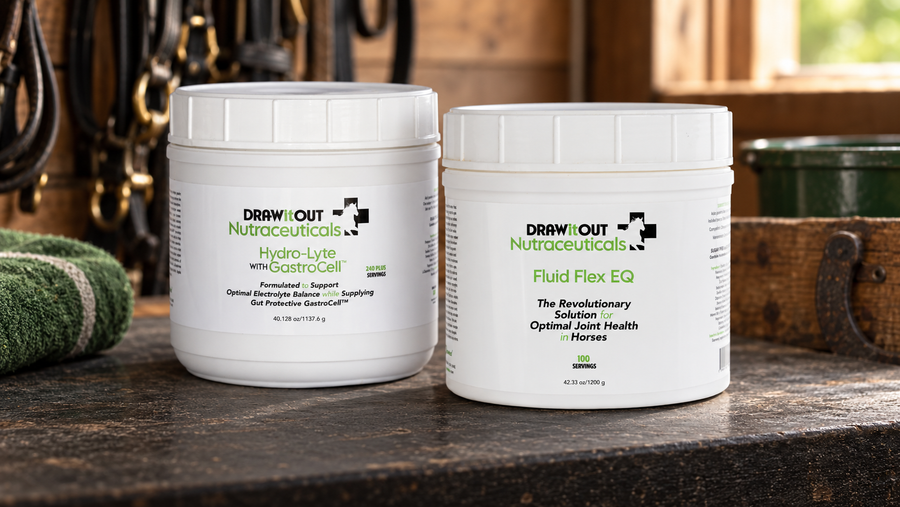
Fluid Flex EQ® is a granulated, feed-through horse joint and mobility supplement from Draw It Out Nutraceuticals. The current label serving supplies 100 mg of sodium hyaluronate. The single container provides 100 label servings, and the two-pack provides 200 total label servings.
That makes the buying math clear, but consistency still matters more than the front of the jar. Read the current label, use the directed amount, and record the start date. The Fluid Flex EQ® feeding routine can help the whole barn follow the same plan.
A supplement trial should make the decision clearer, not create a fog of changing scoops and hopeful memory.
Contact your veterinarian for sudden or worsening lameness, marked heat or swelling, a strong digital pulse, unwillingness to bear weight, repeated stumbling, neurological-looking changes, severe pain, fever, or rapid deterioration. A feed-through product cannot diagnose the cause or replace a lameness examination.
Hoof balance, suitable footing, appropriate conditioning, turnout, body condition, warm-up, cooldown, and veterinary care remain foundational. Daily support belongs inside that system.
There is no evidence-based birthday that fits every performance horse. Use workload, history, current movement, veterinary input, and the complete care program to make the decision.
No single product is automatically right for every senior horse. Start with the horse's diet, teeth, feet, body condition, movement, health history, and veterinary recommendations.
Follow the current label and the evaluation period recommended by your veterinarian. Record a baseline and keep other variables as stable as practical so the trial can teach you something useful.
No. Feed-through joint support and external topical care are different lanes. Compare them in the horse liniment versus joint supplement guide.
Start with purpose, not age. Know the horse's normal, make sure a supplement is actually the right lane, then feed and evaluate it consistently. See Fluid Flex EQ® sizes, current label details, and cost per serving.
Care note: This article is educational and does not replace veterinary diagnosis, treatment, or individualized nutrition advice. Follow current product labels and applicable competition rules.
See every declared ingredient in Hydro-Lyte® and Fluid Flex EQ®, why it is included, how each formula differs, and what the Draw It Out® name on the front...
A year-round horse joint supplement can fit an individual plan, but consistency, label discipline, seasonal management, and regular review matter.
Keep a horse joint-supplement routine consistent during travel with labeled storage, a serving log, clean handoffs, feed-acceptance checks, and missed-serving safeguards.
!