Should You Feed a Horse Joint Supplement Year-Round?
Direct answer
A horse joint supplement can be fed year-round when it fits the horse's individual plan and the current label, but every horse does not automatically need one. If you and your veterinarian or equine nutrition professional choose daily support, consistency usually produces cleaner observations than repeatedly stopping and restarting with the weather. Seasonal changes should first change management, not invite improvised serving changes.
“Should I feed it year-round?” is really four questions: Does this horse need a supplement? Is the formula and declared serving appropriate? Can the barn feed it consistently? And how will you judge whether the routine still earns its place?
Year-round does not mean automatic
Daily joint support can make sense for a performance horse, a mature horse, a horse with a heavy travel schedule, or an individual whose veterinarian has recommended a nutritional support plan. It should not become a substitute for soundness evaluation, hoof care, conditioning, turnout, body condition, saddle fit, warm-up, cooldown, or appropriate footing.
If you are deciding whether to begin, use the horse joint supplement starting guide. There is no universal birthday or workload that makes every horse need the same product.
Why consistency matters
Cleaner observations
A stable routine makes it easier to compare movement, warm-up, workload, feed acceptance, and next-day response without guessing which recent change mattered.
Fewer feed-room errors
A written daily routine reduces missed servings, duplicate servings, and confused handoffs when several people care for the horse.
Honest value review
Consistent feeding gives you a fairer basis for deciding whether the product still fits the horse and the budget.
Label discipline
Weather changes do not authorize doubling, loading, tapering, or combining products outside the current label or professional guidance.
What should change with the seasons?
| Seasonal change | Review first | Do not assume |
|---|---|---|
| Hard or frozen ground | Footing, speed, duration, warm-up, shoeing, turnout, and post-work checks | That more supplement can cancel unsafe footing or excessive work |
| Reduced winter movement | Turnout, hand-walking, warm-up time, water intake, and body condition | That stiffness is always weather-related |
| Spring workload increase | Conditioning progression, feet, tack, recovery, and baseline movement | That a supplement replaces gradual fitness |
| Summer heat and travel | Hydration, electrolytes when appropriate, cooling, hauling, and rest | That joint support treats heat stress or dehydration |
| Show-season schedule | Feed-room handoffs, storage, label servings, and missed-serving notes | That doubling after a missed serving is appropriate |
For away-from-home consistency, use the show-barn joint supplement routine.
A practical year-round review calendar
- Set the baseline. Record normal movement, warm-up time, workload, turnout, feet, body condition, current supplements, and feed acceptance.
- Follow the current label. Do not create a loading dose or seasonal serving change unless the label or qualified professional directs it.
- Review after meaningful changes. Revisit the plan after a workload jump, layoff, injury, diagnosis, medication change, feed change, or major life-stage change.
- Audit the complete stack. Look for duplicate ingredients, unnecessary complexity, and products that no longer have a clear job.
- Schedule a value check. Ask whether the horse still fits the original goal, whether the routine is sustainable, and what evidence would justify keeping or changing it.
What to compare before buying
The UC Davis Center for Equine Health advises shoppers to look for clearly indicated ingredients and fillers, realistic claims, an established manufacturer, and relevant published research. Read its overview of equine joint supplementation and the evidence questions buyers should ask.
Then compare the actual daily serving, not only the package front. Review format, palatability, declared amounts, cost per day, and whether the barn can feed it consistently. The horse joint supplement buying guide organizes those questions in one place.
Where Fluid Flex EQ® fits
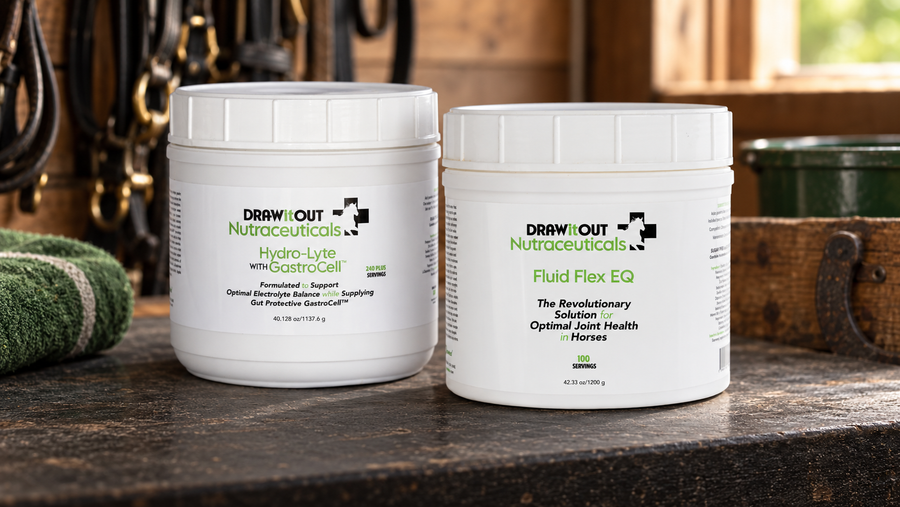
Fluid Flex EQ® is a granulated, feed-through horse joint and mobility supplement from Draw It Out Nutraceuticals. The current label supplies 100 mg of sodium hyaluronate per serving. The single container provides 100 label servings for $99.99, about $1 per serving. The two-pack provides 200 total label servings for $189.99, about $0.95 per serving. Current retail orders ship free within the United States.
Use the Fluid Flex EQ® feeding routine for label-first daily handling, and check the joint supplement cost-per-day guide before choosing a size.
When a supplement is not the next step
New or worsening lameness, heat, swelling, hoof pain, non-weight-bearing behavior, stumbling, weakness, neurologic-looking changes, severe soreness, fever, or sudden reluctance to move needs professional evaluation. Do not wait for a supplement trial to answer an urgent question.
Daily support with a clear job
Choose consistency, then keep reviewing the whole horse.
Fluid Flex EQ® gives the feed room one measured joint-support lane with 100 mg of sodium hyaluronate per current label serving.
Shop Fluid Flex EQ®Frequently asked questions
Should every horse take a joint supplement year-round?
No. The choice depends on the individual horse, diet, workload, history, veterinarian or nutrition guidance, and the goal of the routine.
Should I increase the serving in winter?
Do not change the serving because the weather changed. Follow the current label and ask a veterinarian or equine nutrition professional before changing the plan.
Can I stop during a layoff?
Review the goal with the professional guiding the horse's plan. A layoff changes workload, but it may also change movement, turnout, body condition, and other variables that matter.
Does Fluid Flex EQ® need a loading dose?
Use the amount and schedule on the current label. Do not add a loading phase unless the label or qualified professional specifically directs one.
Does a joint supplement replace lameness evaluation?
No. Supplements support a nutritional routine. They do not diagnose or replace veterinary or farrier evaluation.
Source reviewed: UC Davis Center for Equine Health. Browse the Fluid Flex EQ® answer map or read when supplements are not enough.