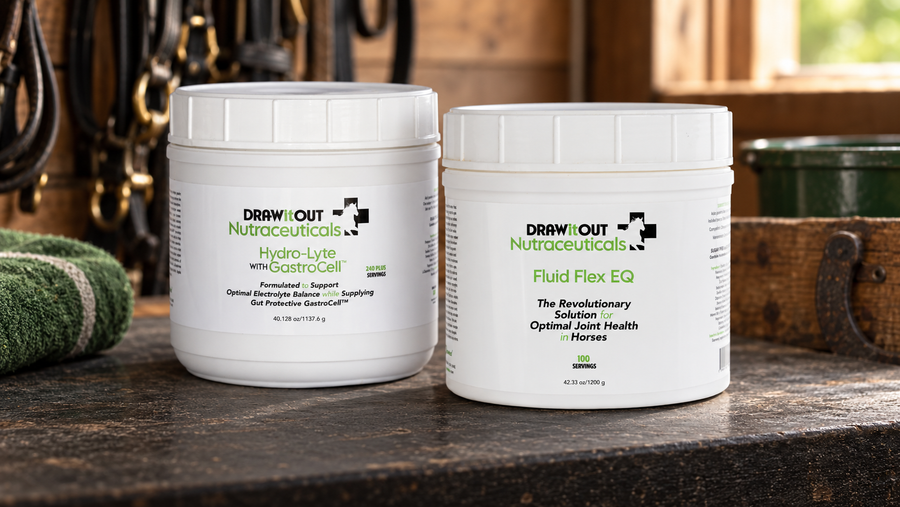
What’s in Hydro-Lyte® and Fluid Flex EQ®? The Name on the Front Matters
See every declared ingredient in Hydro-Lyte® and Fluid Flex EQ®, why it is included, how each formula differs, and what the Draw It Out® name on the front...

Horse owners often ask whether they should buy a liniment or a joint supplement as if one has to beat the other. That is the wrong contest. One is an external body-care format. The other is a daily feed-room program. They work in different lanes and ask different things from the barn.
Quick answer
Choose horse liniment for an external, area-specific routine connected to work, hauling, standing time, or hands-on body checks. Choose a joint supplement for a consistent daily feed-through program built around longer-term observation. Some horses use both. Neither should be used to cover new lameness, heat, swelling, pain, or a sudden change in movement.
| Question | Horse Liniment | Joint Supplement |
|---|---|---|
| Where does it fit? | External body-care routine | Daily feed-room routine |
| What does the barn do? | Apply, observe, and recheck | Feed consistently and track over time |
| Timing | Often connected to a ride, haul, or specific check | Same label-directed serving on a repeatable schedule |
| Best evaluation | Before-and-after area and movement notes | Feed acceptance, movement, workload, and longer trend |
| Replaces veterinary care? | No | No |
A liniment belongs in hands-on horse care. You are looking at a particular area, comparing both sides, checking the skin, and deciding whether an ordinary topical routine makes sense after work, hauling, or standing.
The Draw It Out® 16oz Liniment Gel is the ready-to-use, stay-put format for targeted placement. It is odorless and colorless and made without menthol, camphor, capsaicin, alcohol, or witch hazel. The lack of theatrical heat or tingle keeps the focus on the horse and the check.
A topical is not a way to hide a new problem. If one leg is hotter, more swollen, painful, or paired with lameness, stop the routine and call your veterinarian.
A joint supplement lives in the feed room. Its value depends on consistent feeding, label-directed use, feed acceptance, and a useful baseline. Changing several supplements, feeds, shoeing variables, and workloads at once makes it difficult to know what changed or why.
Fluid Flex EQ® is a granulated Draw It Out Nutraceuticals joint and mobility supplement that supplies 100 mg of sodium hyaluronate per label serving. The current container provides 100 label servings, with a two-container option for barns that already know the routine fits.
Judge a supplement by declared amount per serving, format, palatability, cost per serving, and whether the barn can feed it consistently. Do not judge it by package size alone.
Start with the need, not the category.
They can exist in the same whole-horse program because one is topical and the other is feed-through. That does not mean every horse needs both, and it does not turn two support tools into a diagnosis or treatment plan.
The cleaner approach is to define the job of each product. The liniment supports the external routine. The supplement supports the daily feed-room routine. Conditioning, turnout, footing, hoof care, body condition, warm-up, cooldown, saddle fit, and professional guidance still matter.
See the complete Inside + Outside Horse Recovery collection if you want to compare the two lanes without confusing them.
With liniment, you are buying a repeatable external routine and the format that makes it easy. With a supplement, you are buying declared servings and the discipline to feed them consistently. The expensive product is the one the barn cannot use correctly, cannot measure, or forgets on the shelf.
That is why the practical starting points are a ready-to-use 16oz Gel for targeted topical care and the 100-serving Fluid Flex EQ® container for a daily feed-through plan.
Choose Draw It Out® 16oz Liniment Gel for targeted external care. Choose Fluid Flex EQ® for daily joint and mobility support. Use the Solution Finder when the category is still unclear.
No. They are different formats with different routine roles. A feed-through supplement does not perform the same job as an external topical.
No. Liniment is an external body-care product. It is not a daily feed-through program.
Follow the current label and use a consistent evaluation window recommended by your veterinarian or the product guidance. Avoid inventing a loading phase or changing several variables at once.
Follow the current product label and check the skin and horse each time. Routine use never cancels the need to investigate a new change.
Lameness, wounds, significant heat or swelling, non-weight-bearing behavior, fever, neurologic-looking changes, sudden weakness, or a rapidly worsening condition belongs with a veterinarian. The American Association of Equine Practitioners care guidance lists lameness and wounds among the concerns that should be discussed with a veterinarian.
Educational product guidance only. Follow current labels. Supplements and topicals do not diagnose, treat, cure, or prevent disease and do not replace veterinary or farrier care.
See every declared ingredient in Hydro-Lyte® and Fluid Flex EQ®, why it is included, how each formula differs, and what the Draw It Out® name on the front...
A year-round horse joint supplement can fit an individual plan, but consistency, label discipline, seasonal management, and regular review matter.
Keep a horse joint-supplement routine consistent during travel with labeled storage, a serving log, clean handoffs, feed-acceptance checks, and missed-serving safeguards.
!